Caridyne - Overview
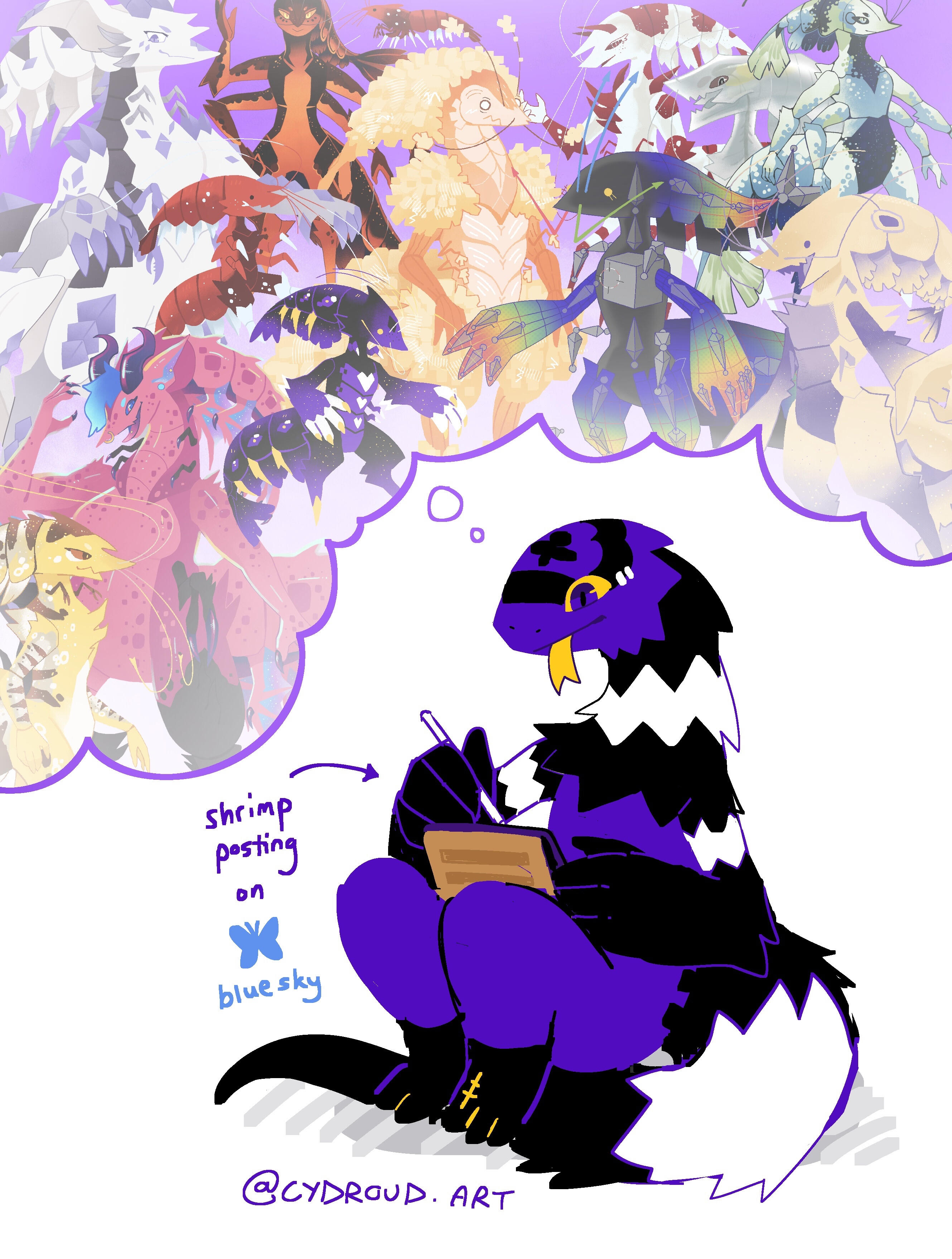
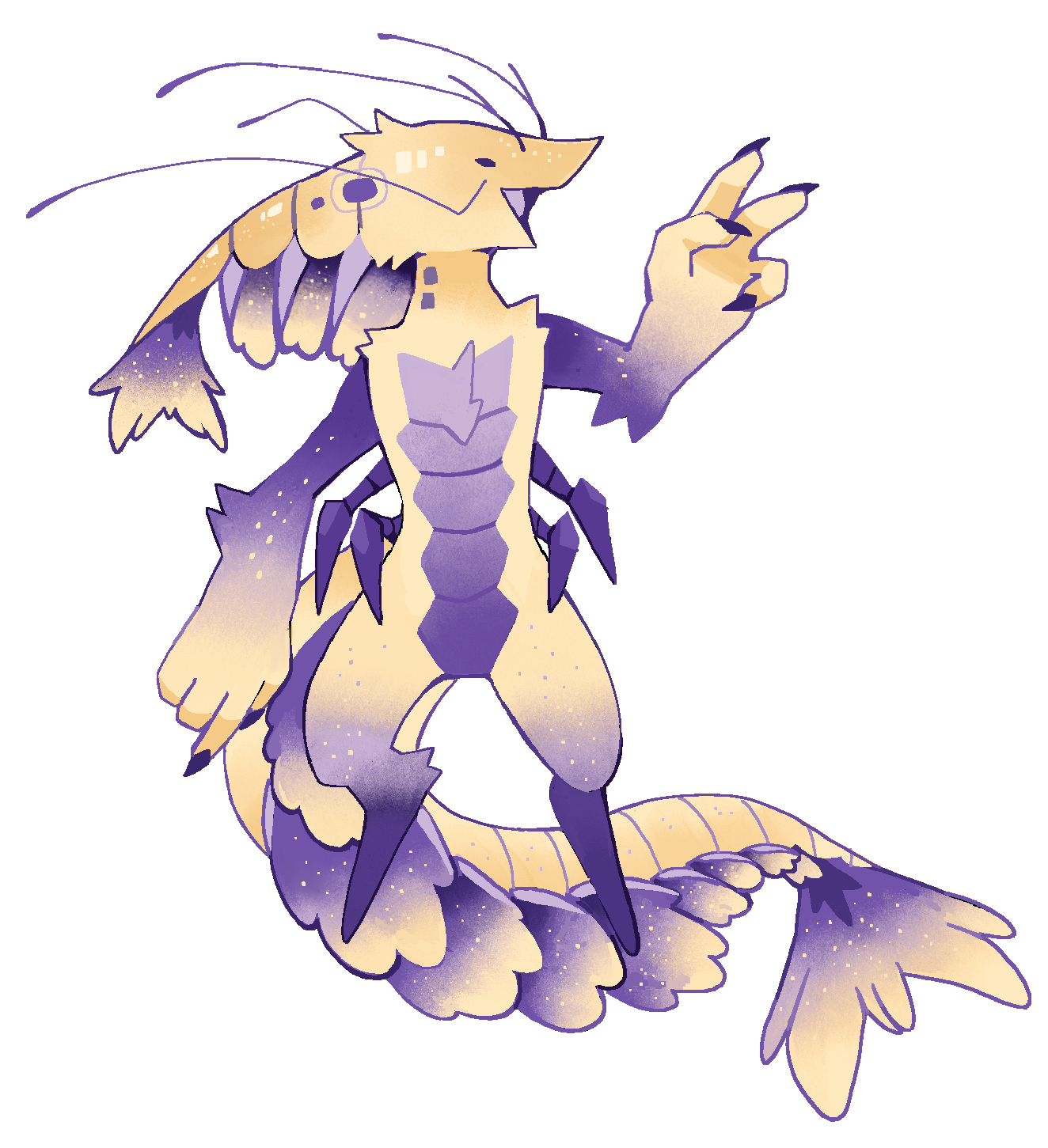
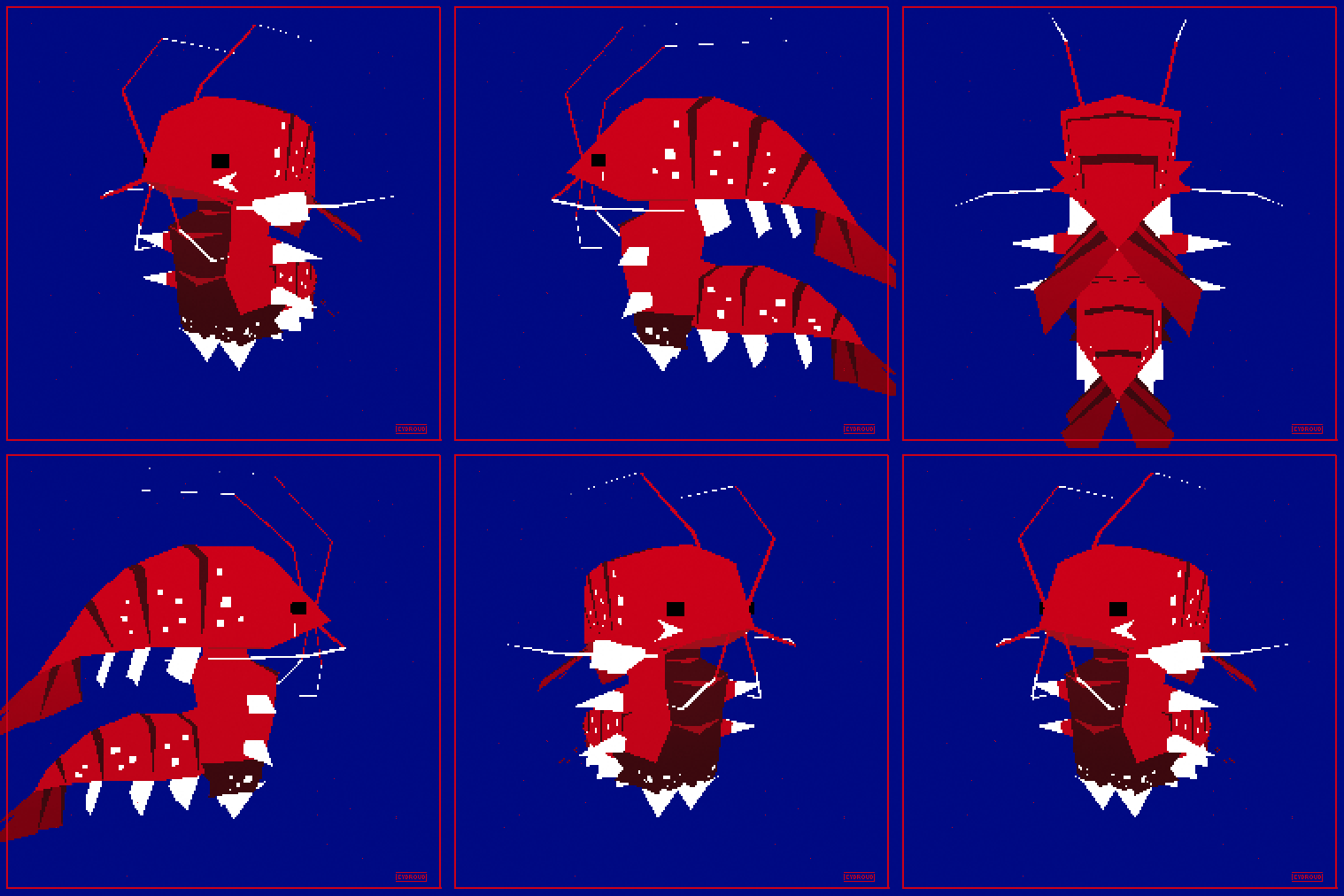
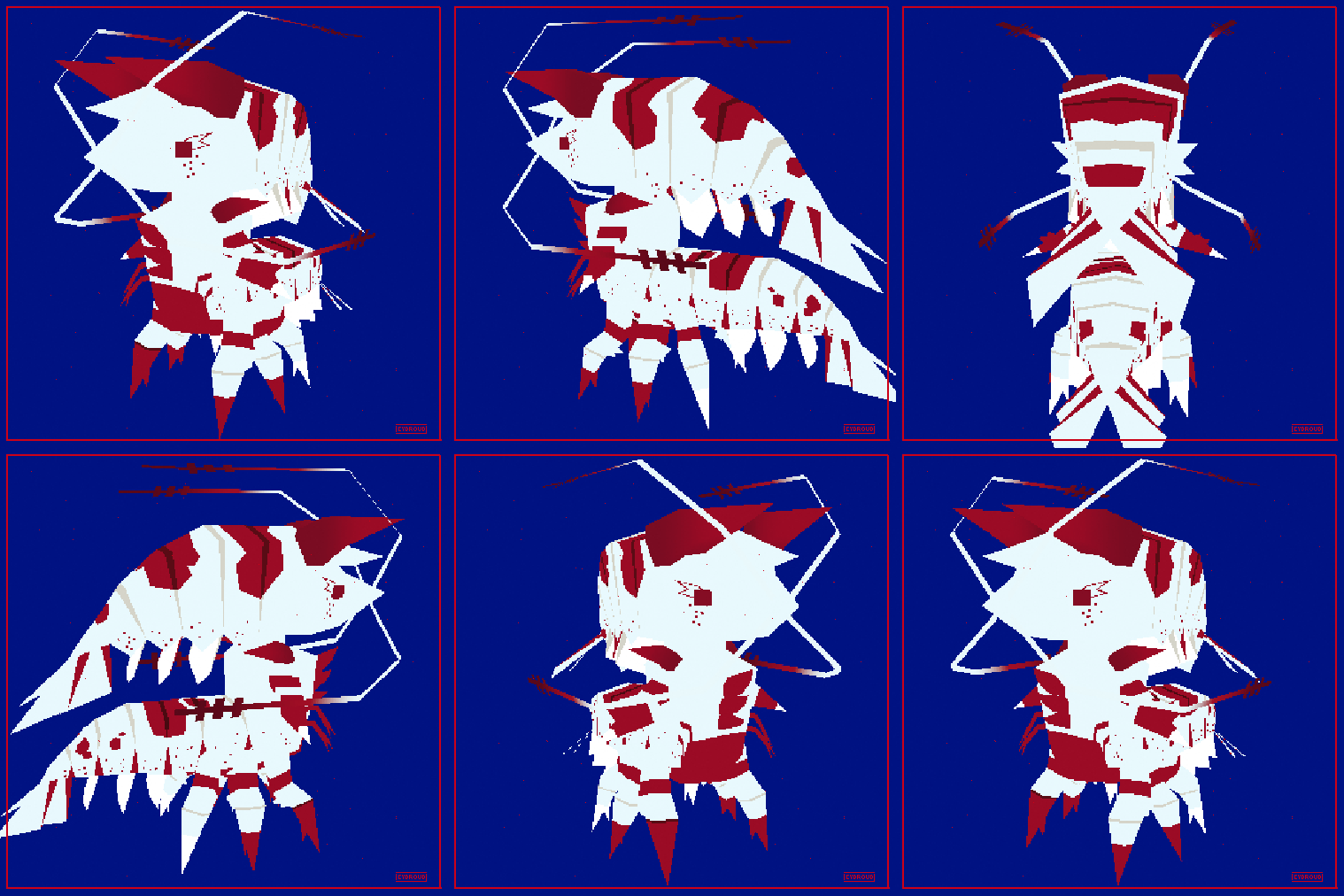
Caridyne (pronounced care-ih-deen) are an ever adaptive species of anthropomorphic crustaceans. Their native habitats range from fully aquatic to semi-aquatic environments. Being a tenacious species, fluidity and change are central to their identities. Throughout their adulthood, they are capable of changing their forms to several specialized body types depending on their environment. Hybridization is common with this species due to their adaptive genetics. As a result, there are countless individuals with unique biology stemming from Caridyne ancestry.Caridyne are known best for their signature head crest, which fans out into a tail. All Caridyne, including hybrids, possess this trait.Caridyne are an open species. Feel free to take inspiration from any and all notes included here!
Caridyne - Biology
An outline of the life of the Caridyne species. The mechanisms of the actual species itself. From their first moments as an egg to the end of their lives as elders.
Life Cycle
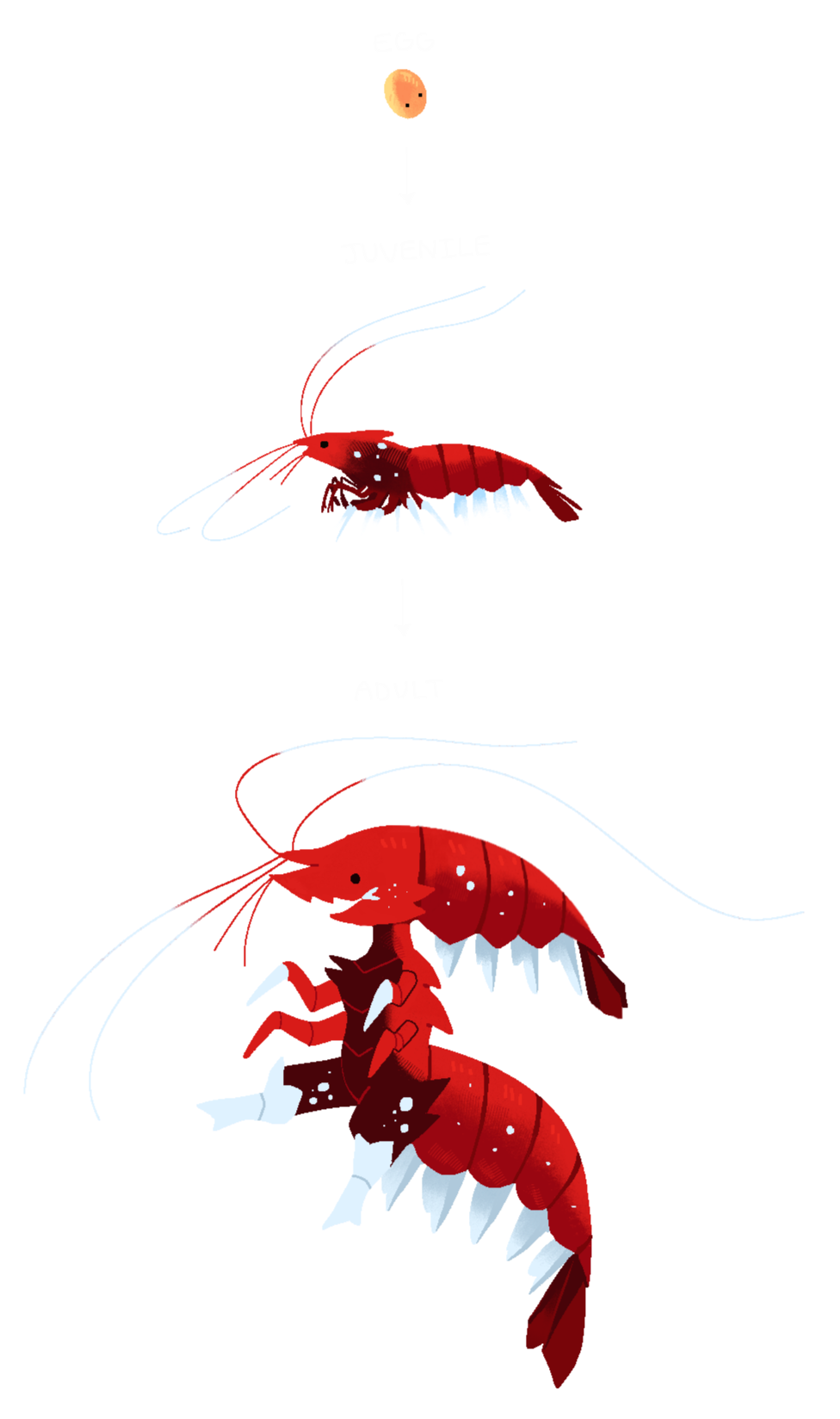
All Caridyne start off life as eggs. The eggs are an oval shape with a semi-translucent casing. Fertilized eggs are carried by their parents under their tails for ~3 months until they hatch. A parent must stay underwater for the entire duration of their development, otherwise the eggs will dry out. A Caridyne who has lived most of its life in or near freshwater will need to carry its eggs in freshwater. The same goes for those who primary reside in saltwater or brackish water. Many Caridyne will return to the body of water they were born in as they nurse their eggs.Caridyne have a juvenile stage where they visually look like a normal, non-sapient shrimp save for a single spike on the backs of their heads. The spike on the back of their heads as juveniles eventually develop to become their iconic head crest. The young shrimp will molt periodically, shedding their exoskeleton and becoming slightly larger as they age. Once they reach maturity, they molt into their adult form, which is is initially dictated by the parents' physiology. The Caridyne may further molt into different, specialized body types depending on their environment.Once an adult, a Caridyne can live indefinitely with enough food and a stable environment. The main threats to a Caridyne's life are predation, hunger, illness, and failed molts. As a Caridyne gets older, molting becomes increasingly dangerous. An older Caridyne may struggle to remove their exoskeleton when they need to molt. The likelihood of an older Caridyne's exoskeleton being too soft or hard for them to escape from increases with age. Often times older Caridyne will have others help them remove their exoskeleton if they are struggling to do so.
Growth - Molting
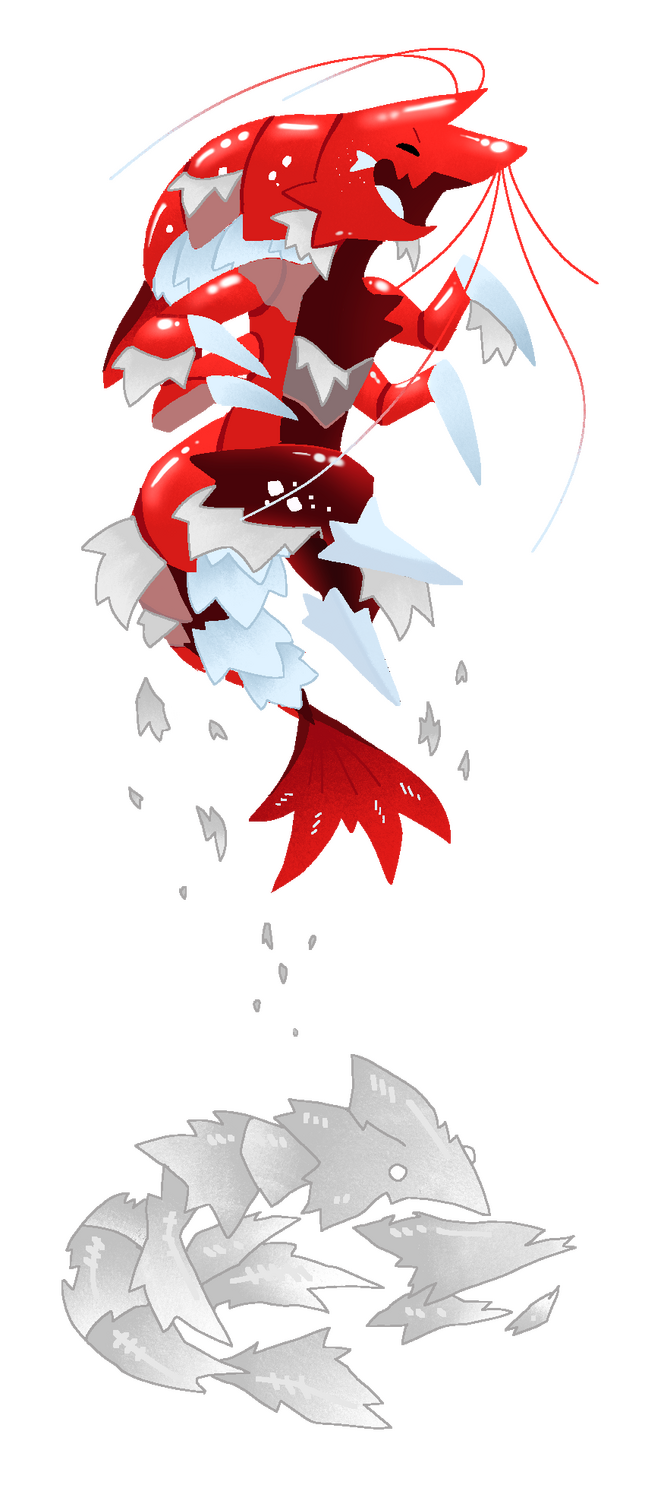
Prior to a Caridyne molting, they tend to eat plenty of calcium rich foods in order to prepare for the creation of a new exoskeleton. A Caridyne will burst out of its old exoskeleton quickly, now slightly larger but extremely soft. They are in the most danger during their post-molt phase due to their lack of any defenses. These shrimp tend to hide while their exoskeletons harden.Molting allows the Caridyne to recover lost limbs and repair general damage to the body. Recovered limbs may take several molting cycles to regenerate. New limbs will appear smaller and weaker at first until enough molt cycles bring the limb to its original functionality. Additional creation of limbs or the loss of limbs due to adaptation happen after a molt.Despite having incredible regenerative capabilities, some severe injuries may be unable to be healed if the damage results in deeper psychological trauma.If a Caridyne is living in unsuitable conditions, unhealthy, or older, molting becomes an increasingly dangerous process. Risks can include the shrimp being unable to burst out of its own exoskeleton, resulting in death. Proper care must be taken in order to prevent this from happening.
Regeneration
A Caridyne that is injured will tend to have jagged edges on the damaged exoskeleton, while any exposed muscle tissue will be soft and gooey in appearance. Injuries that occur at joints have an easier time regenerating. Joints can be willingly closed and severed, creating a clean cut. The closed off joint then allows for any tissue not contained within the node to fall away with minimal harm to the Caridyne. It is important that an injured Caridyne avoid further harm due to an imbalance in walking gait or swimming from missing body parts. As the Caridyne gets closer to molting, their exoskeleton becomes duller and lighter. The process is known to make the body itchy and uncomfortable. When the Caridyne finally molts, it initially comes out of its shed very soft. Injured body parts regenerate at different speeds depending on the severity of the injury.
Reproduction
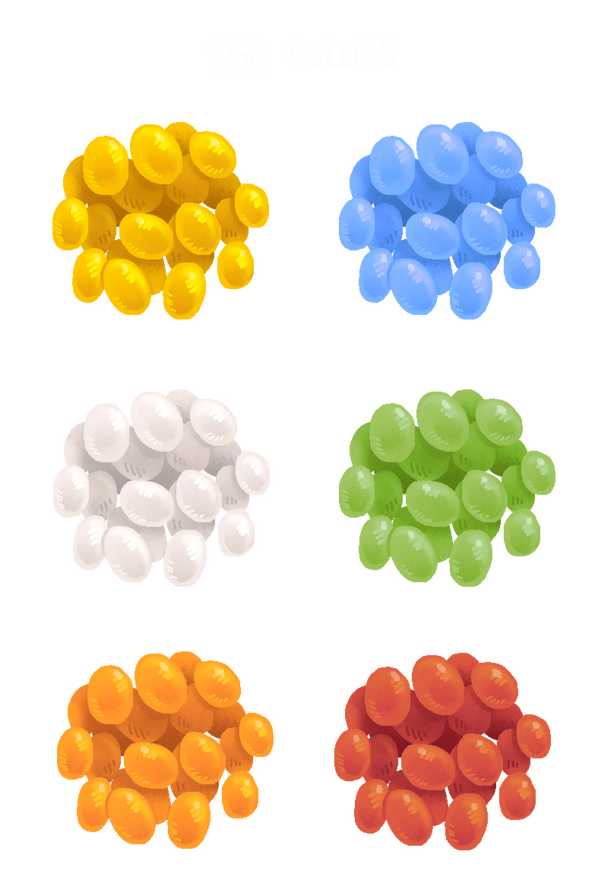
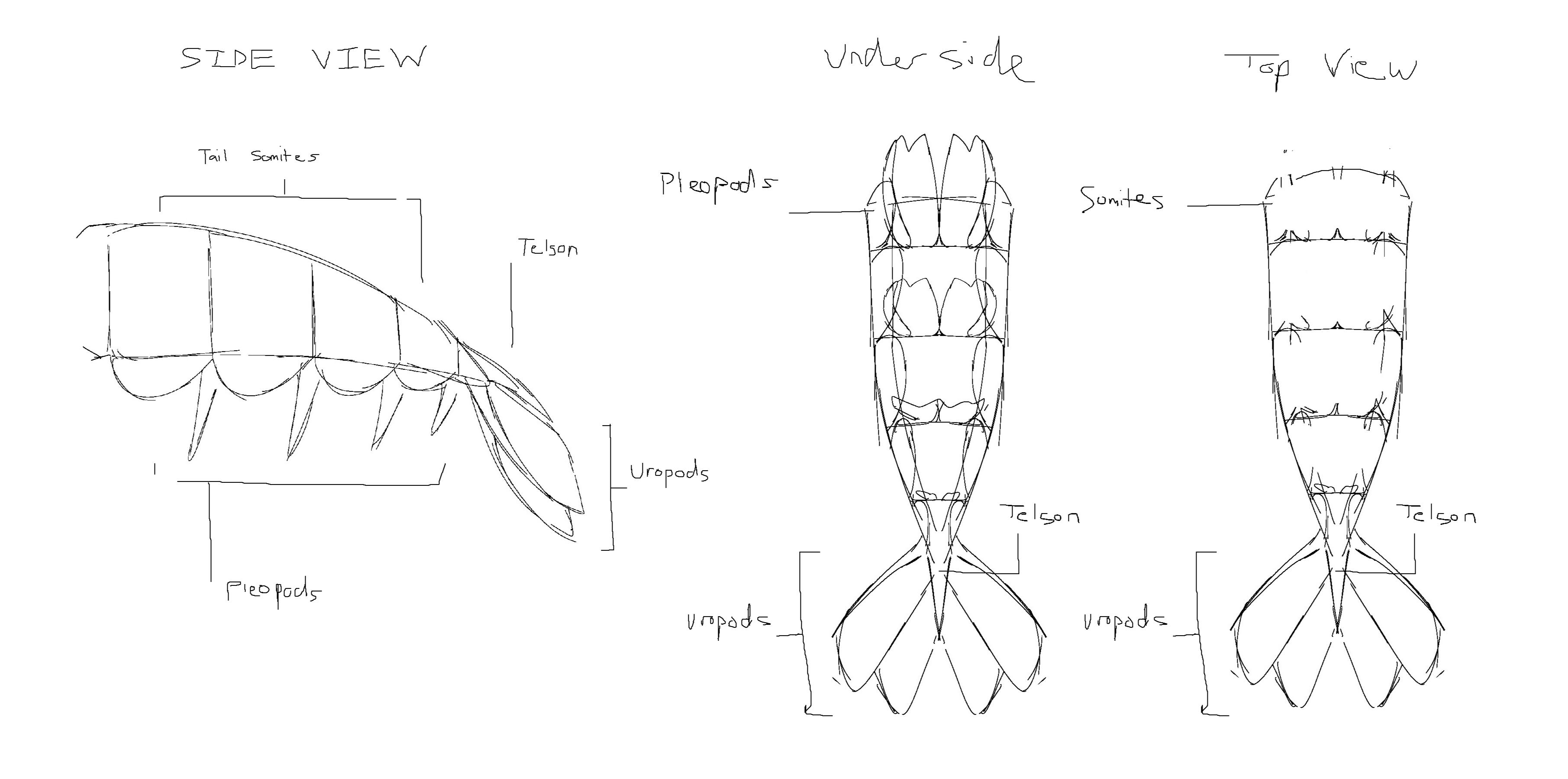
Mature adults can carry unfertilized eggs at the base of their tail. They are held in what is called a "saddle," which can be visible from the exterior depending on the transparency of the Caridyne's chitin. After a molt, a Caridyne may release pheromones into the water column to attract a mate. When a Caridyne has mated, the fertilized eggs are then transferred to the pleopods beneath the tail. An ovigerous Caridyne will carry the eggs until they hatch. This phase is often called being "berried" since the eggs look like little fruits hanging from their parent. The parent will periodically fan their pleopods to ensure that the eggs are given enough oxygen and fresh water while they develop. This also prevents algae growth that may harm the delicate eggs.Eggs can come in all kinds of colors and are attached to their parents with a sticky slime.
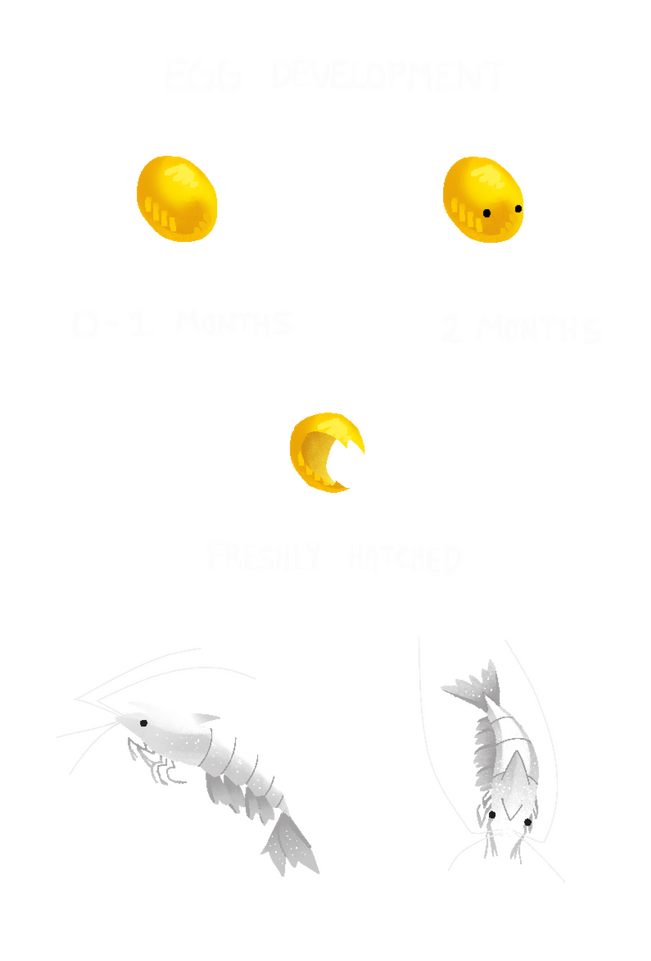
Eggs take about three months to hatch once their parent is berried. The eggs are translucent, which make determining the age of the fry easier. Caridyne shrimplets have visible eyes shortly before they hatch from their eggs. A newly born Caridyne fry will be mostly translucent, with some having small patches of color on their bodies. These newborns will tend to hide in dark places while devouring anything they can get their claws on. They molt quickly as a result, developing colors as soon as a few weeks old.
A berried shrimp is capable of dropping its eggs before they hatch if they desire. This may happen due to injury, stress, or an unsuitable environment. Dropped eggs can still be recovered and fostered if they were fertilized. Otherwise, they often end up as food for other creatures.
Aging

As a Caridyne ages, they grow larger with every molt. They can grow to a maximum size that is dependent on the amount of food they can sustain themselves on. Elders gradually become duller as time goes on, and they get spots and a noticeable aging stripe that runs along their backs.
Illness
Caridyne are sensitive to illnesses present in the water column. They rarely become ill due to airborne interactions. Shrimp that are sick are often first isolated in a body of water which is then treated with various medicines. To avoid spreading illness to those who treat them, Caridyne use waterproof coverings on any body part that comes into contact with the sick shrimp's body. For Caridyne that reside exclusively in the ocean, this proves a difficult challenge. Often times isolating the sick individual near salt lakes or hydrothermal vents can prevent the spread of illness due to the extreme nature of their surroundings. However, treatment must be timely due to the sick shrimp's weakened immune system. The likelihood of a shrimp recovering is dependent on their overall vitality and age.1. Parasitic Algae - Certain algae can infect a shrimp, appearing present in their swimmerets as a fuzzy green growth. This algae deeply imbeds itself between the exoskeleton and into the muscle within, making it extremely difficult to remove manually. The use of high concentrations of salt over a short period of time to spot treat any infected areas works well.2. "Rusting Disease" - A bacteria ever present in the water column may infect shrimp that are older or weakened through injury.3. Copper Poisoning - The element copper has proven extremely toxic to all Caridyne, including adjacent species. Over-exposure to copper can cause all biological functions to dampen, weakening the shrimp if not outright killing it. As a result, Caridyne are highly sensitive when detecting this element and will always avoid it when present.
Morphology
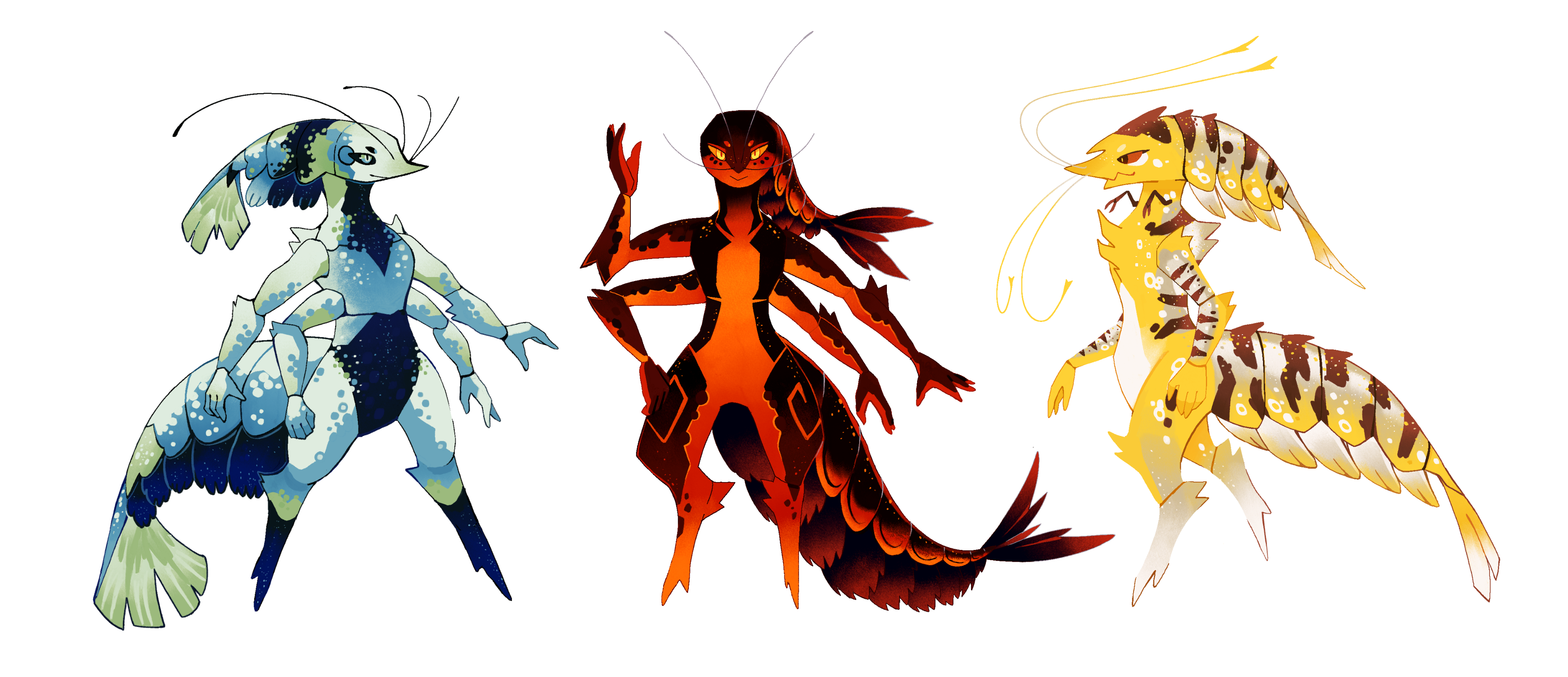
The morphology of the Caridyne species is extensive, with wide variations in shape and size depending on the individual. Similar structures and anatomy can be found in the sub-types of Caridyne, which are adaptations of existing features.Caridyne physiology is heavily inspired by crustacean anatomy. Structures similar to real life crustaceans have many equivalent appearances in Caridyne anatomy.Caridyne morphology can continue to change after their "adult" molt. Caridyne initially molt into a form resembling one or both of their parents. Afterwards, the environment that a Caridyne lives in affects their morphology. While Caridyne initially start off their lives in the water, they are able to adapt to living on land if they choose. All Caridyne possess a head crest.Several different types of arm and leg types have been recorded. Different morphs possess different amounts of limbs depending on the type.Hybrid Caridyne may possess undiscovered types of limbs or morphology depending on what species they are crossed with.
Body Type: Bipedal
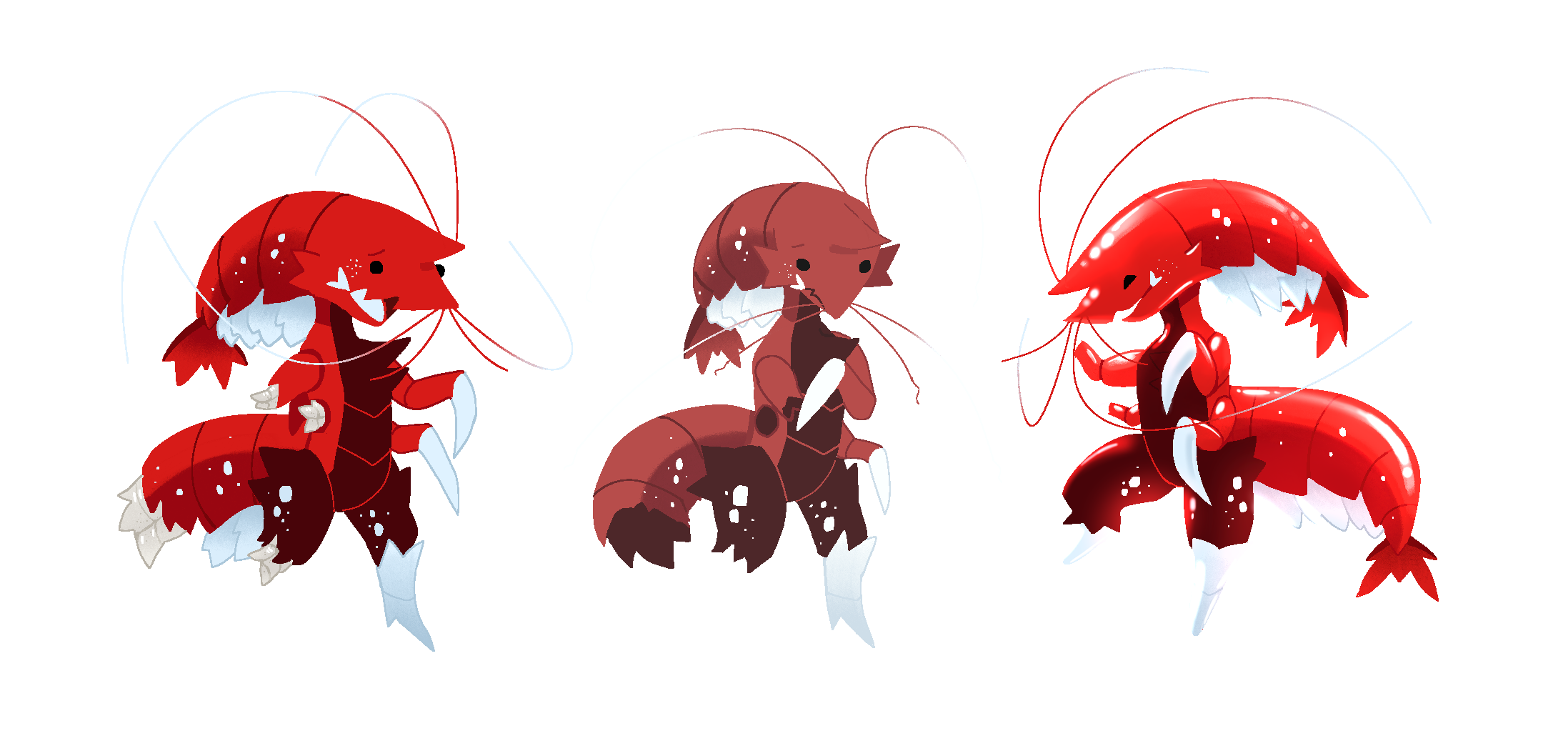
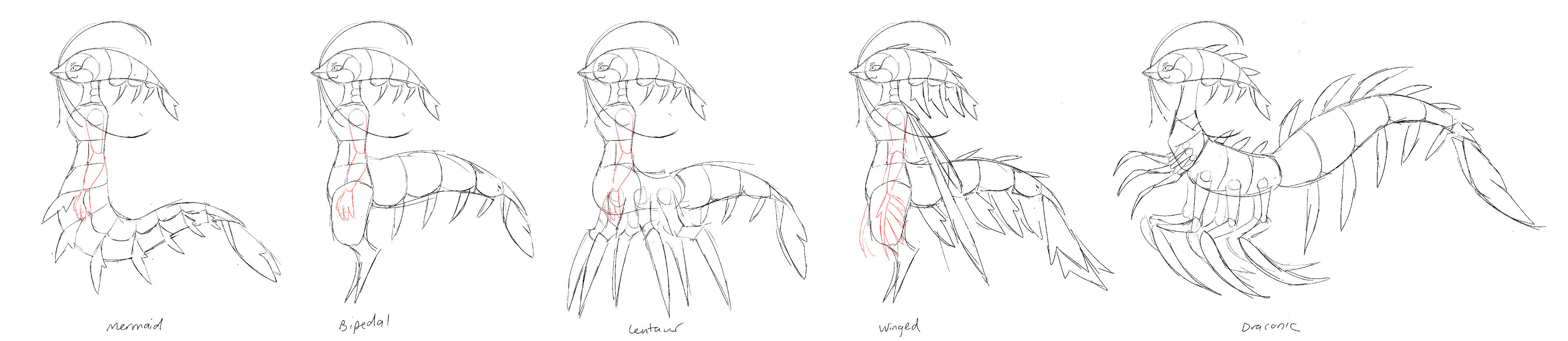
The bipedal body type is the most commonly found among Caridyne. It offers a balance between aquatic and terrestrial mobility, allowing for an individual to reliably navigate both environments. Being a balanced body type, they are not masters of swimming or terrestrial movement. They possess the ability to grow two sets of arms, alongside smaller pseudo arms that run along their necks and torsos. If a Caridyne does not evolve to fit a specific environment, the default adult form of a Caridyne is the bipedal variant.
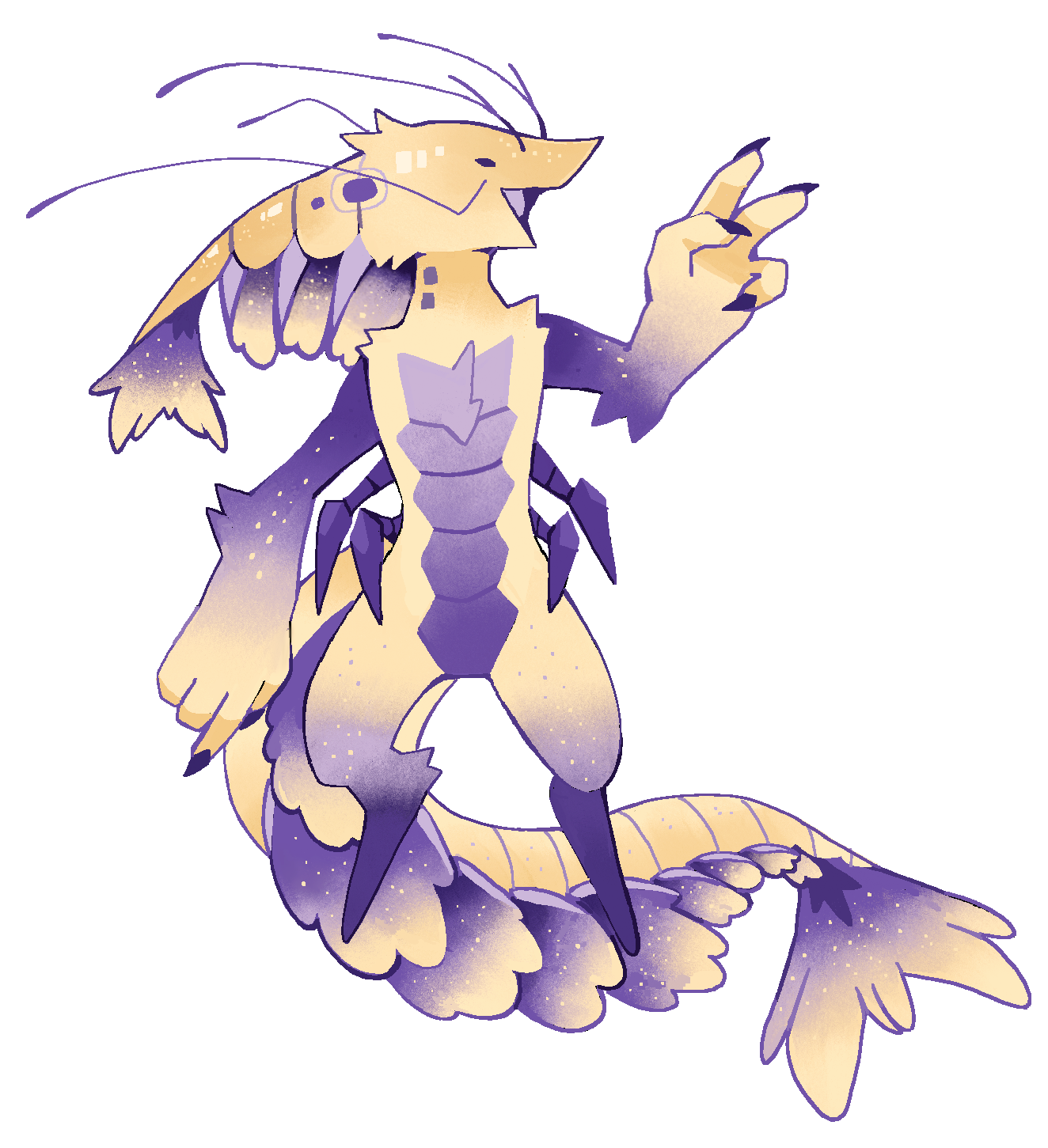
Body Type: Mermaid
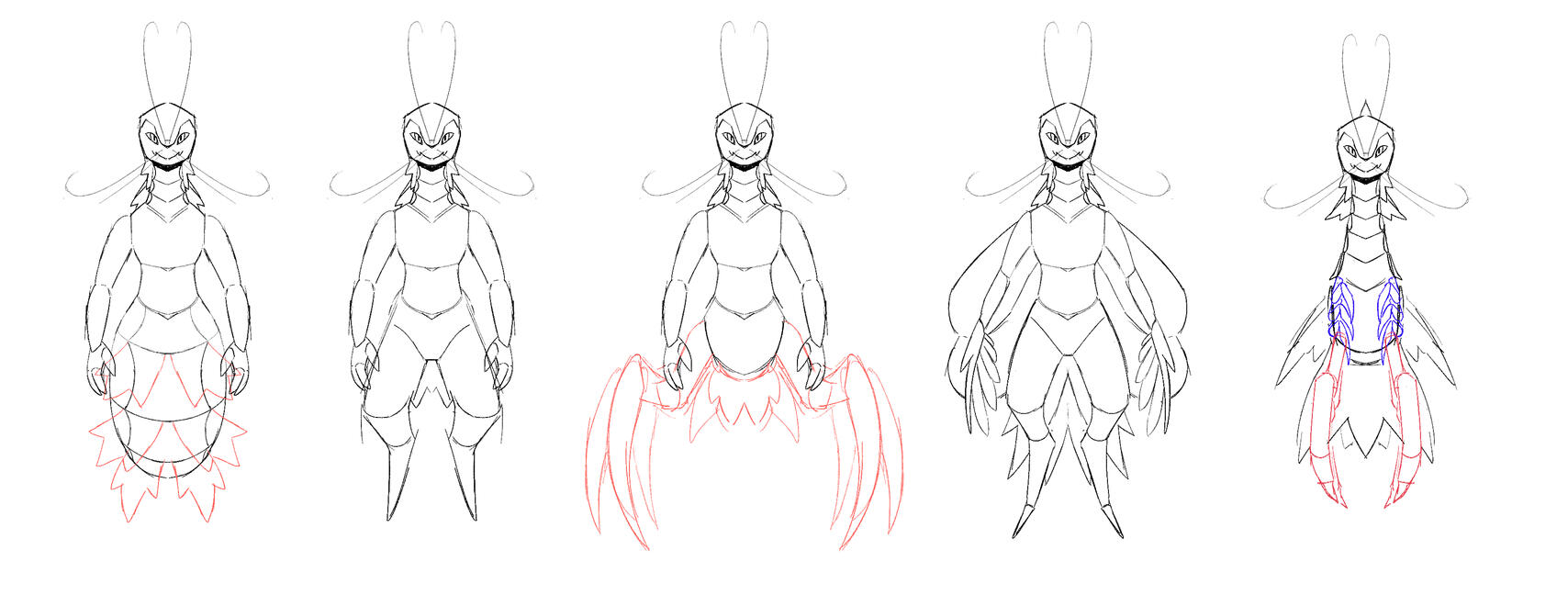
By forgoing the adaptation of legs on the lower half of its body, the "mermaid" variant Caridyne's body becomes streamlined and nimble. Their uniquely evolved tail is stronger than all other variants of its species. The pleopods that run along the bottom of the tail split in two, and help with maneuvering through water. Among the other types of Caridyne, the "mermaid" variant can reach the highest swimming top speeds possible of the species, using their tails to cut through the water with ease. Due to these adaptations, this variant of Caridyne is unable to live outside of large bodies of water, such as oceans and seas. They often spend time near the water's surface when resting. A very rare sub-type of this variant is capable of growing two tails.
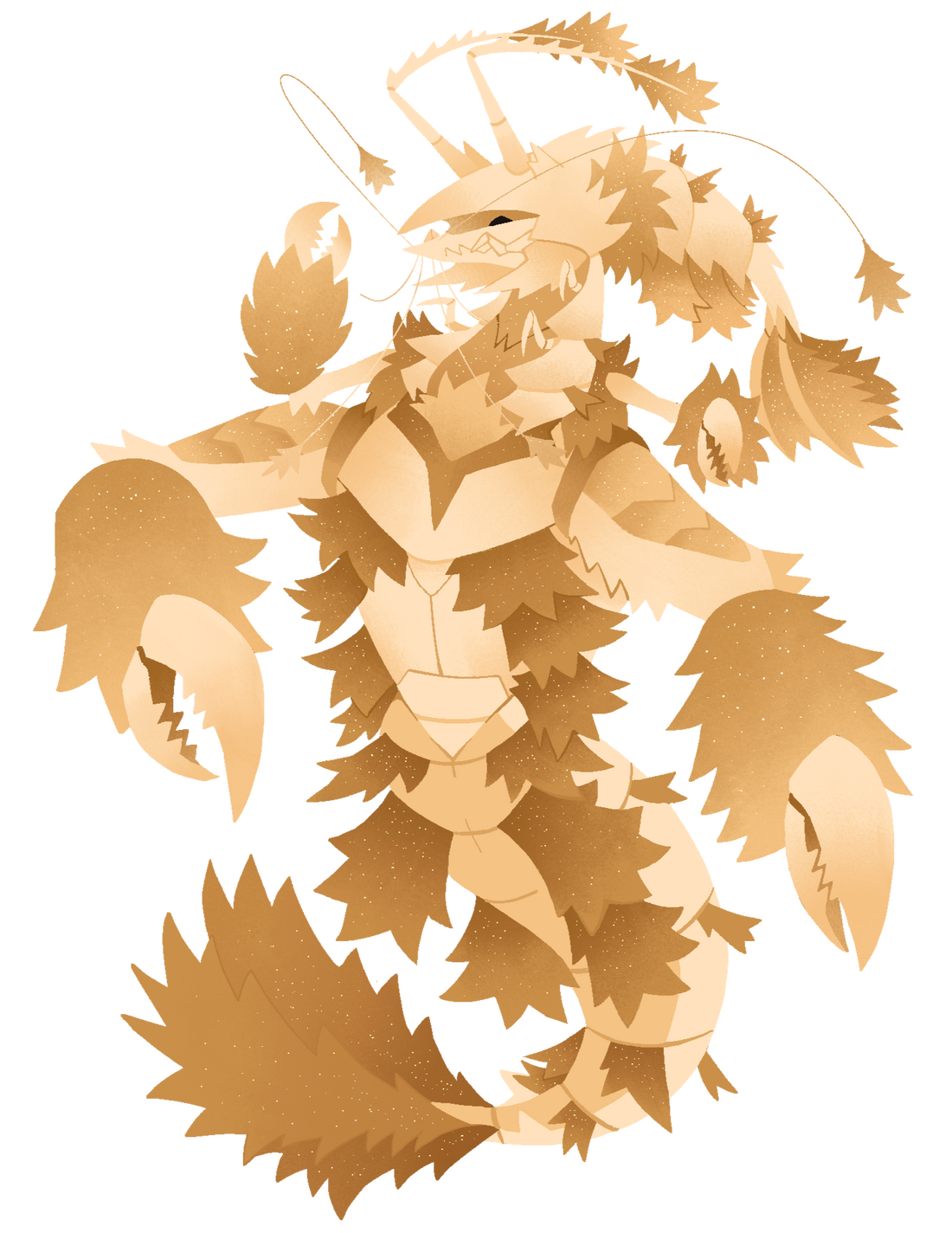
Body Type: Centaur
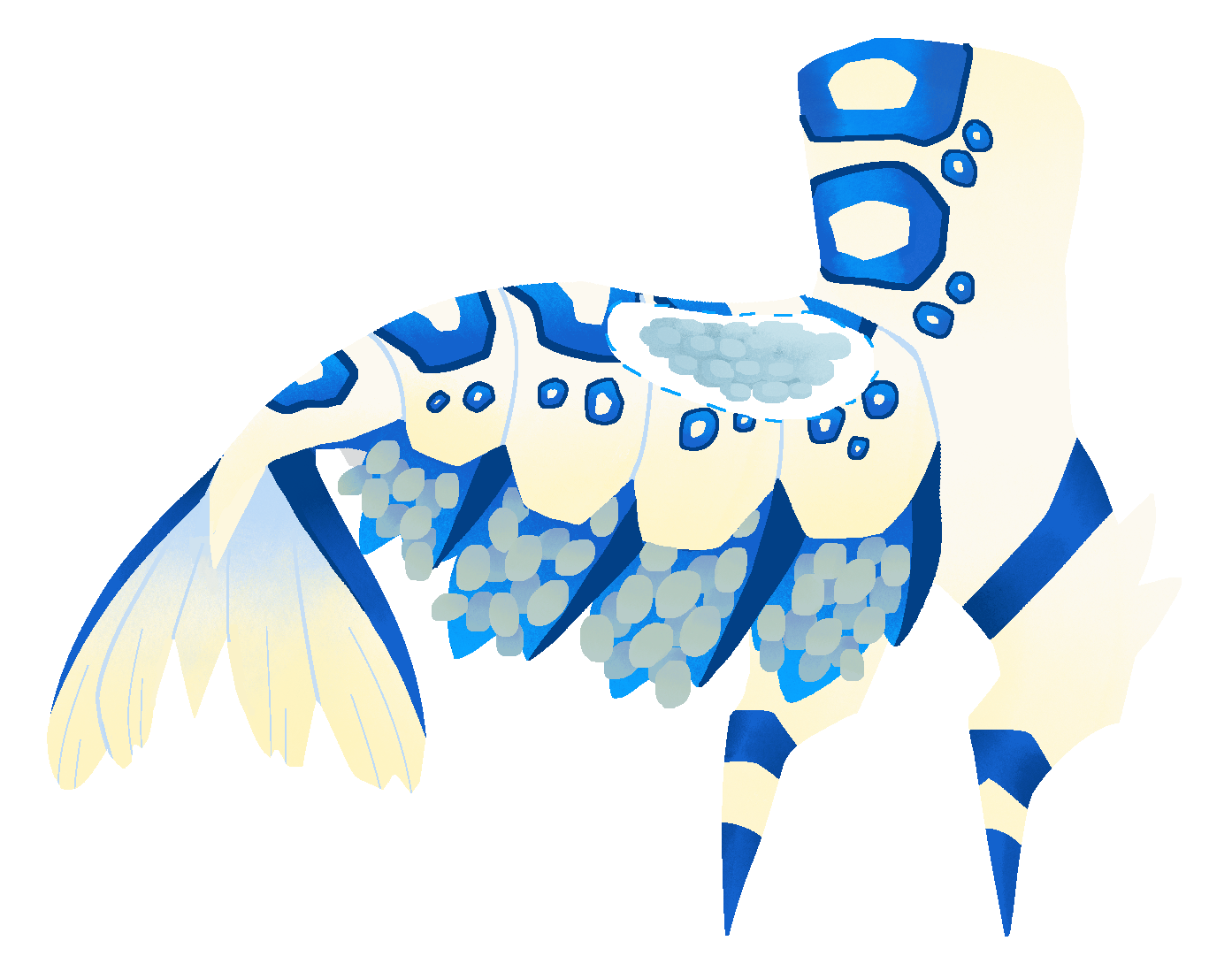
The centaur body type is capable of traversing on land effectively and efficiently. They offer a Caridyne the ability to both have arms and a strong multi limbed lower body. These Caridyne have the fastest land movement speed. Their tails are a shorter than average due to their adaptation to land. A centaur type Caridyne tends to have the most physical strength in their arms and legs.
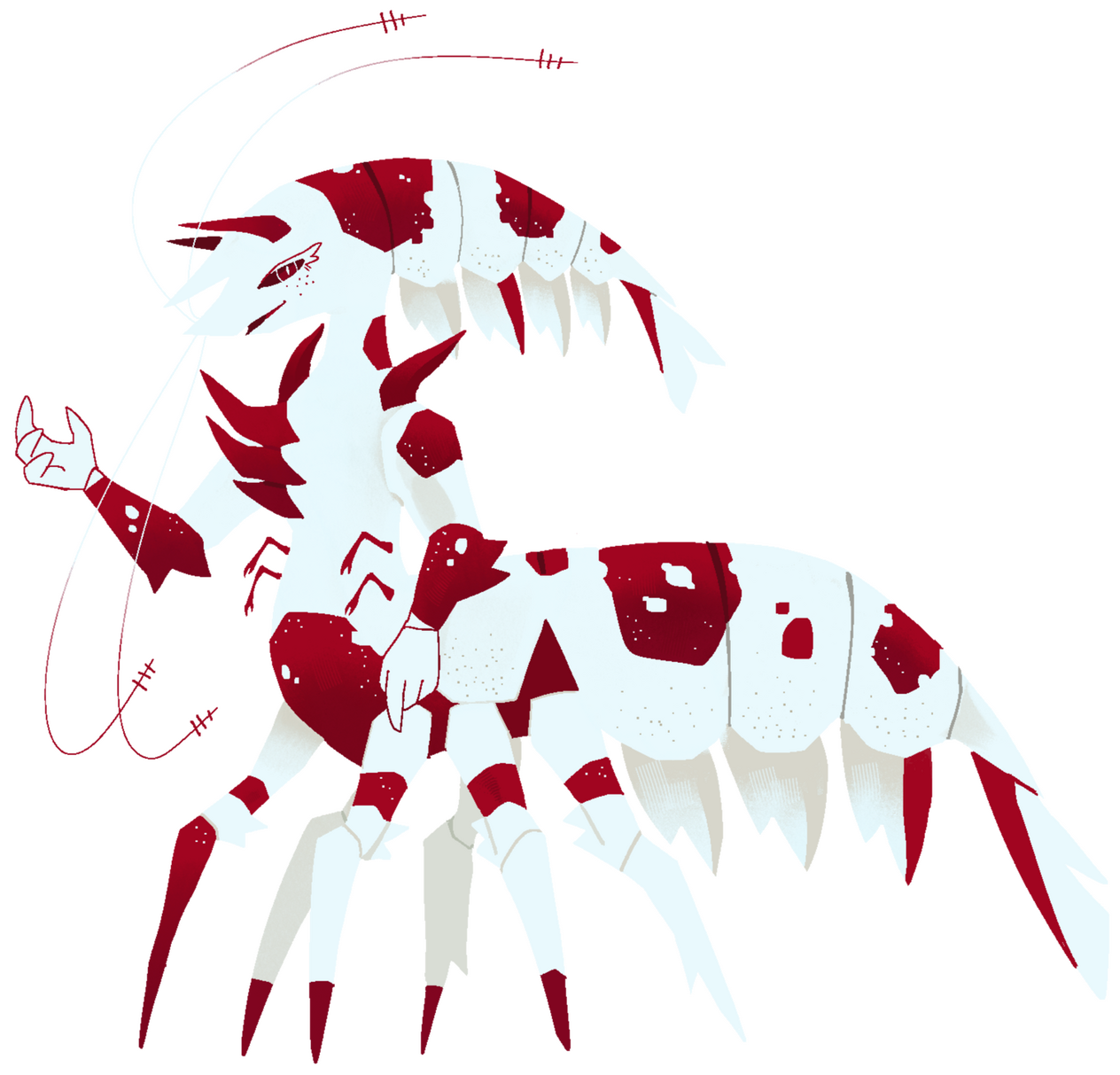
Body Type: Dragon
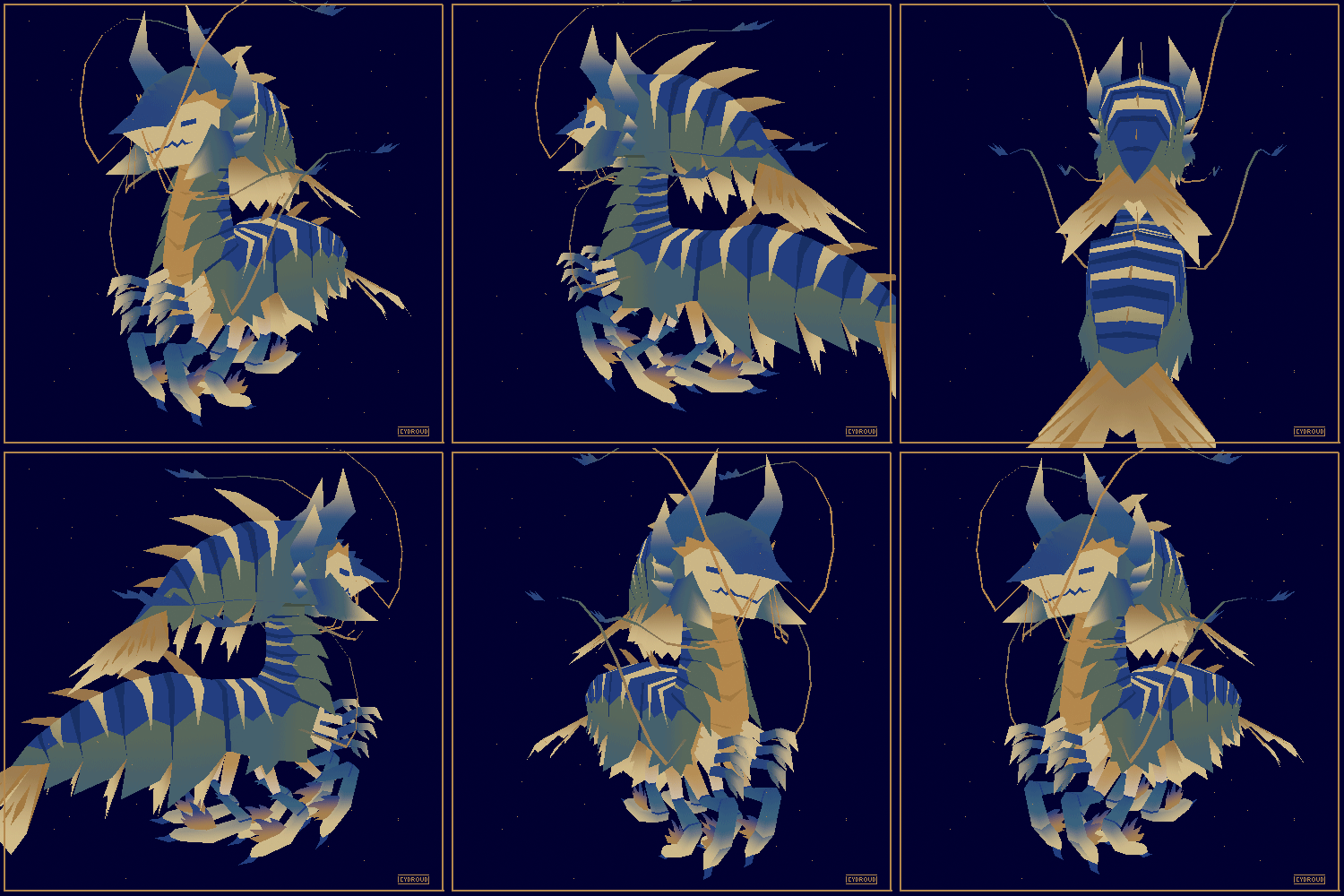
Caridyne with the dragon body type forgo the adaptation of hand-like arms entirely, opting instead to remain as close to their original body type as possible. These Caridyne tend to possess six pseudo arms, six legs, and a very long tail. Their torsos are at an angle that allow the Caridyne to graze algae effectively. This body type does not tend to see use outside of the ocean due to their heavy tails, which are adapted for swimming.
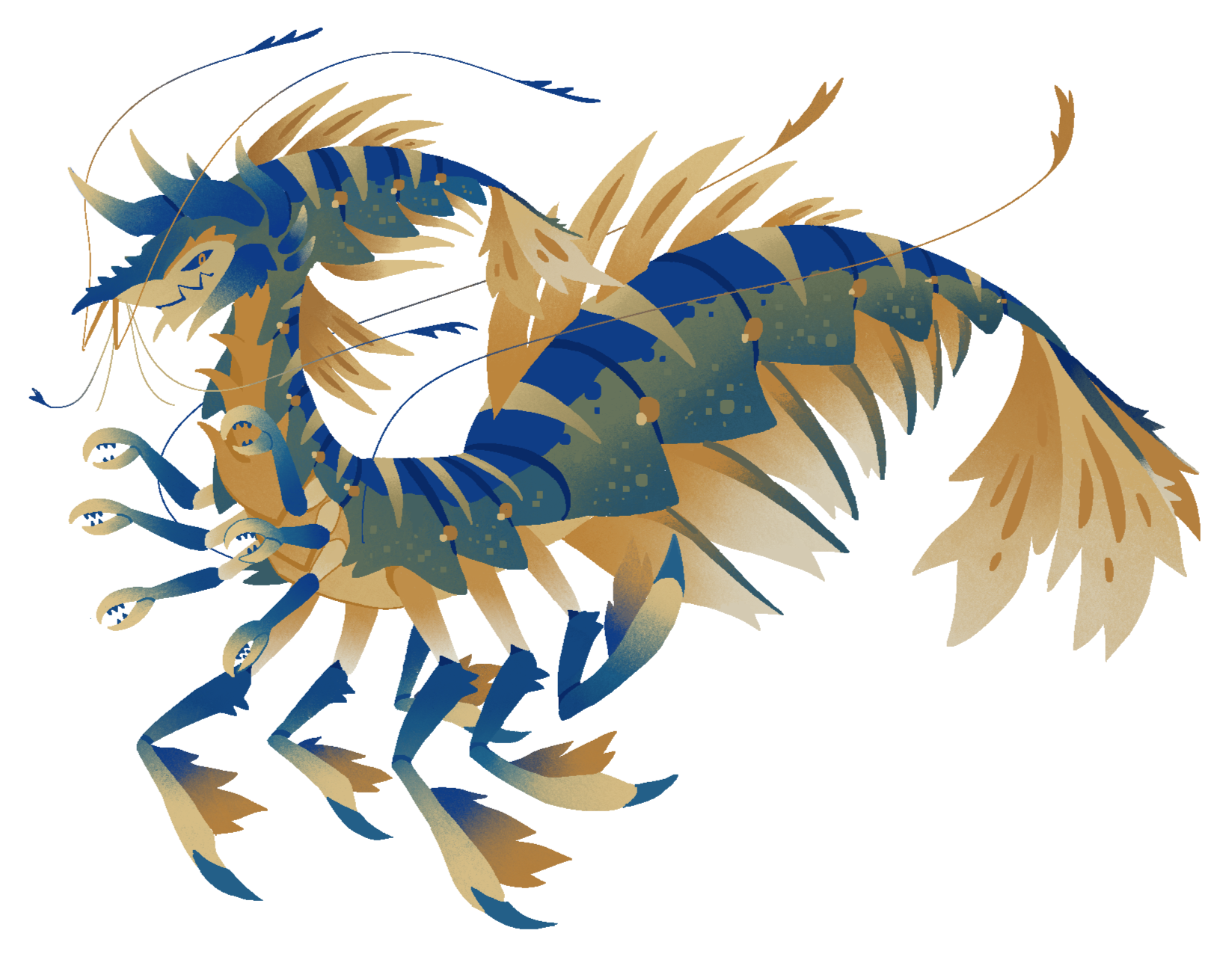
Body Type: Winged
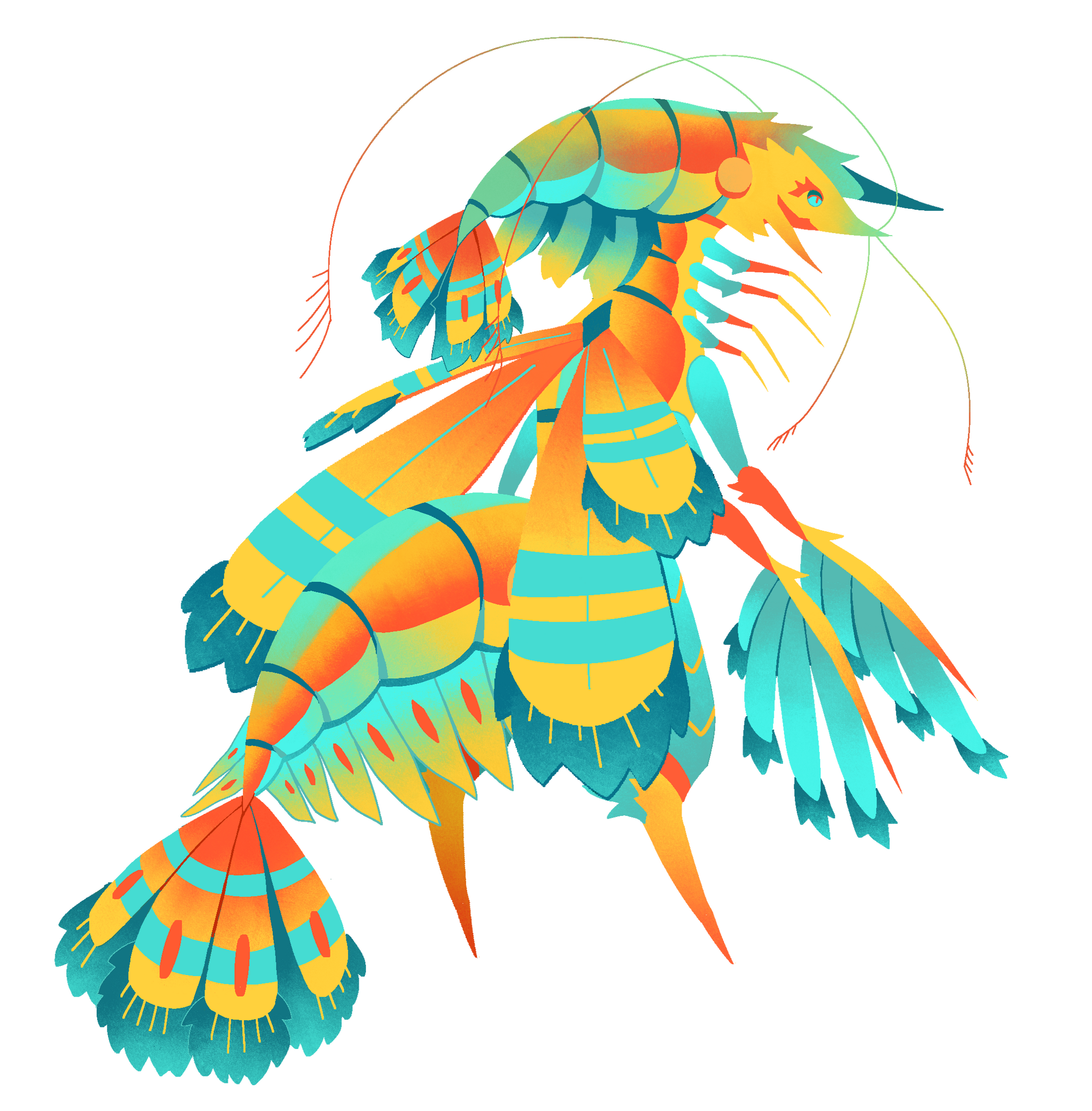
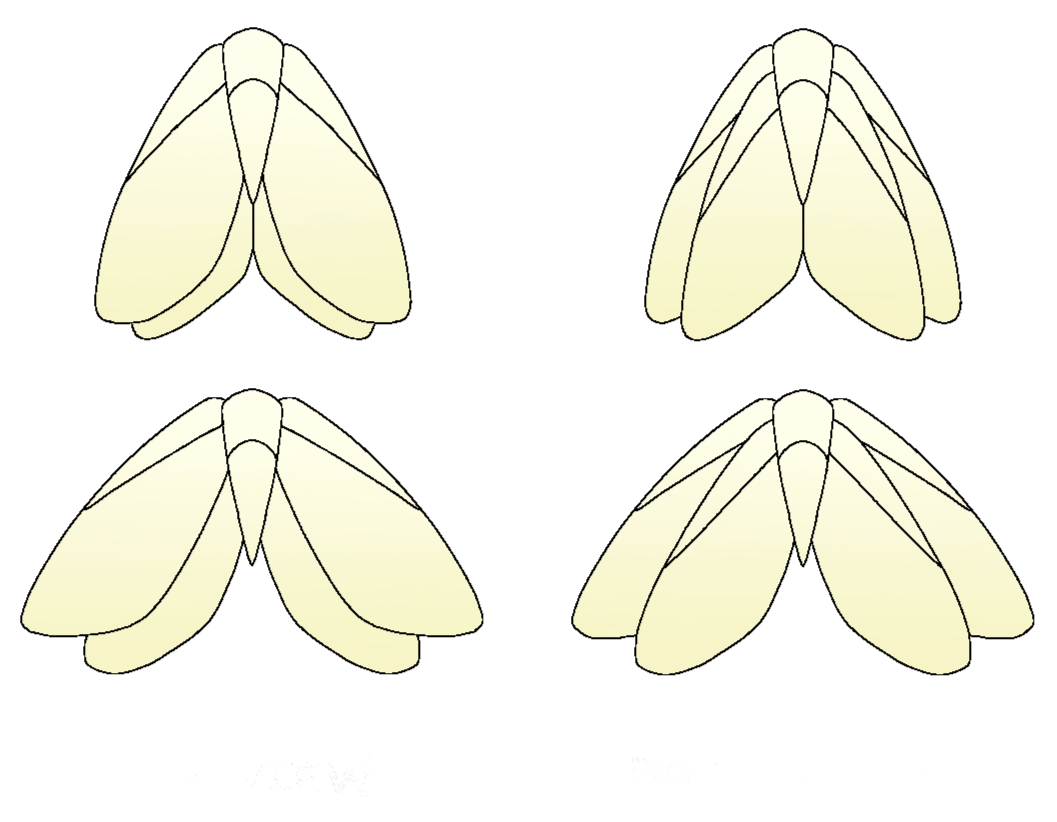
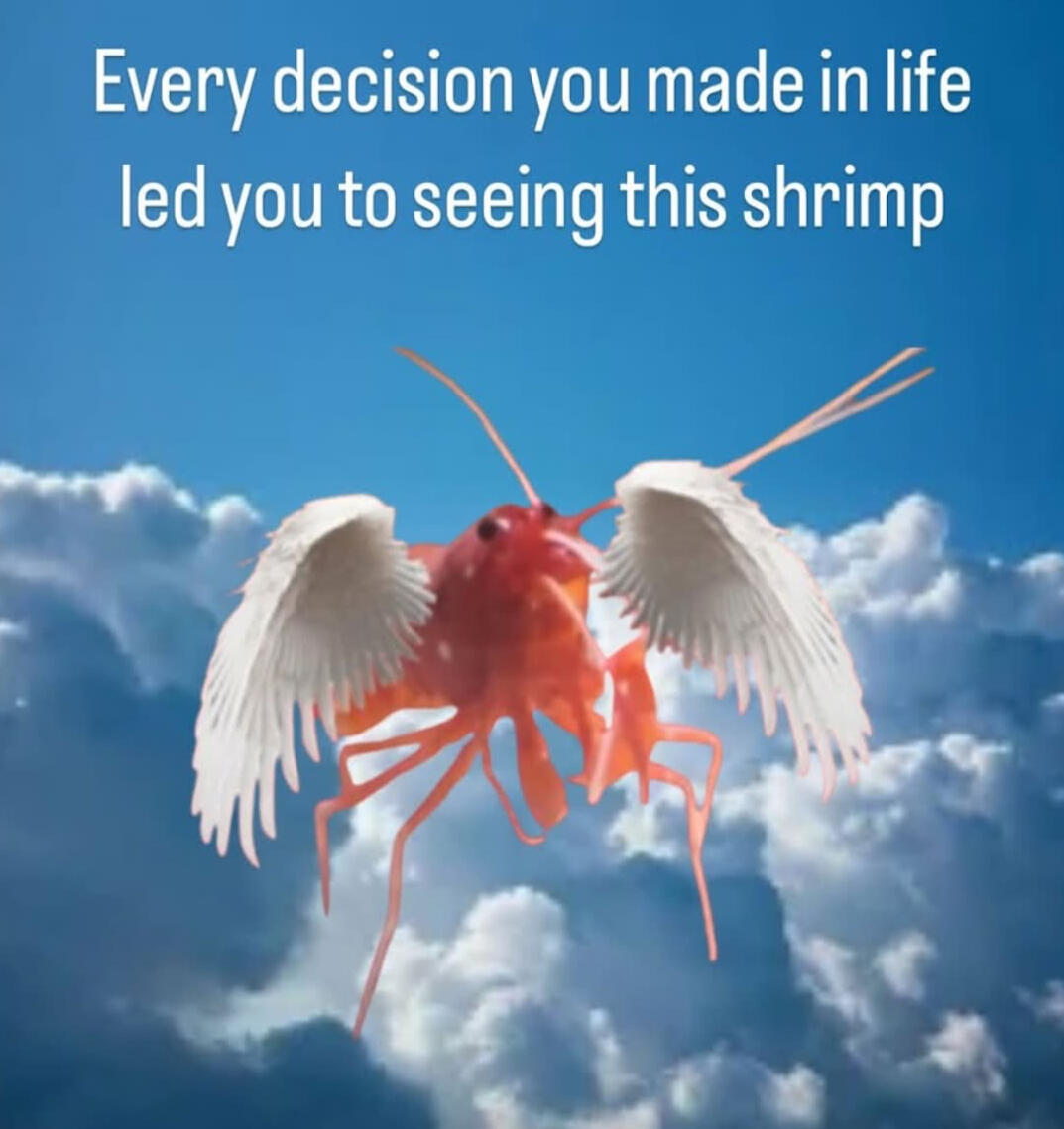
A rare variant of Caridyne adapted their tail fans into a set of wings. These wings function similarly to that of insects. Alongside this adaptation, winged Caridyne tend to have fans coming out of their arms to help aid with movement in the air. Their tails have swimmerettes that fan out of the side of the shrimp instead of under. As a result, these Caridyne are capable of flight, but lose the ability to swim effectively. They remain semi-aquatic, but avoid the deeper ocean due to their adaptation.
Body Type: Hybrid
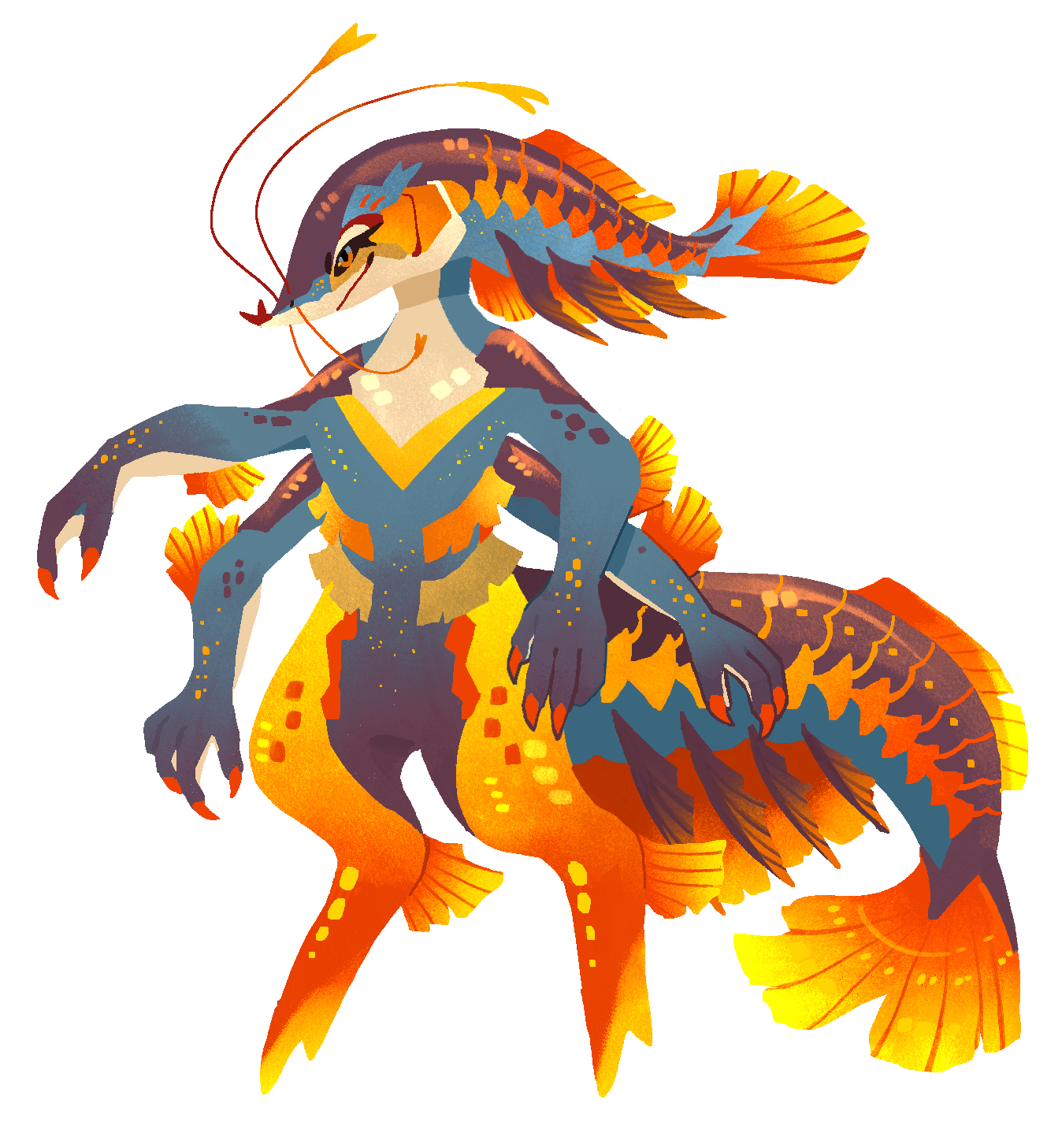
Hybrid Caridyne possess unique traits depending on what species they are crossed with. Features that are similar to parts that already exist on the baseline Caridyne body plan will tend to appear analagously. For example, a Caridyne crossed with a fish might have fins that appear in the place of pleopods and uropods on the shrimp. Biological features of a hybrid Caridyne will be altered due to the nature of its cross. Features unique to Caridyne will remain depending on the level of hybridization it undergoes.
Caridyne are not hostile towards hybrid members of its species, and welcome their differences with open arms. Fluidity is important to Caridyne culture due to their innate ability to change forms.After about five generations removed from Caridyne ancestry, the signature head crest will no longer appear prominently.Hybridization is easier depending on how closely related the crossed species is.
Anatomy - Overview
Anatomy - Tail
Eyes
Caridyne eyes are come in two main types - eyestalk and non-eyestalk variations. Caridyne can possess eyes with pupils or compound eyes. Double eyed variations tend to appear more commonly with hybridized individuals. More uncommonly seen are double eyed shrimp with two different types of eyes.
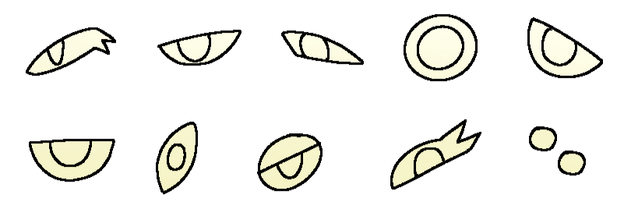

Caridyne vision is complex, with the average individual being able to see colors beyond what most other creatures can see. Their eyes possess photoreceptors that allow them to see ultraviolet and polarized light. This ability is most prominent in Caridyne that stay close to the water. Those who spend more time on land tend to lose this ability due to a lesser need to observe color changes through the distortion of water.
Head
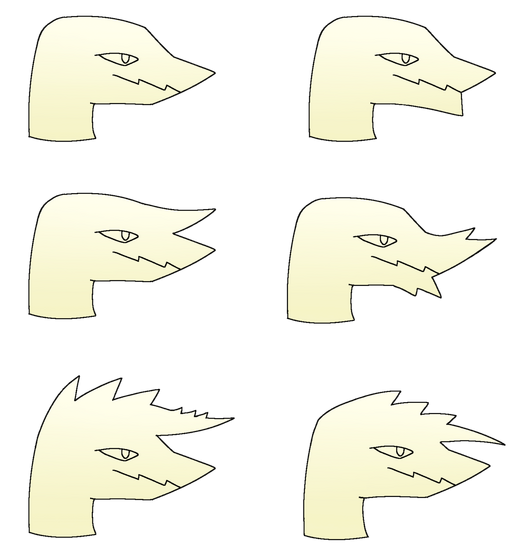
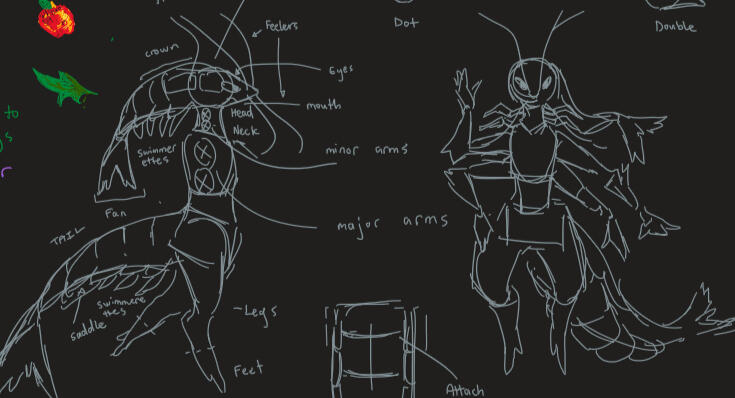
Caridyne heads have the following features. Spikes can protrude from the top of the head or from the sides of the jaws. Horns can also grow from the chitin that forms around the face plate. Various spikey and spiny growths can be present on these protrusions. A Caridyne's "nose" always ends in a point, with spikes commonly present along the ridge leading up to the tip. The mouth can either be a traditional opening/closing jaw, or a filter feeding sieve that partially opens.All Caridyne possess what is called a head crest, but is more colloquially referred to as their "head-tails" or false tails. These develop once a Caridyne reaches maturity. The crest is physically similar to a shrimp's traditional tail, however it does not carry young or produce waste. The pleopods present on the head are used to express emotion and communicate. The crest is considered a sensitive part of their bodies due to their delicate nature.
Antennae
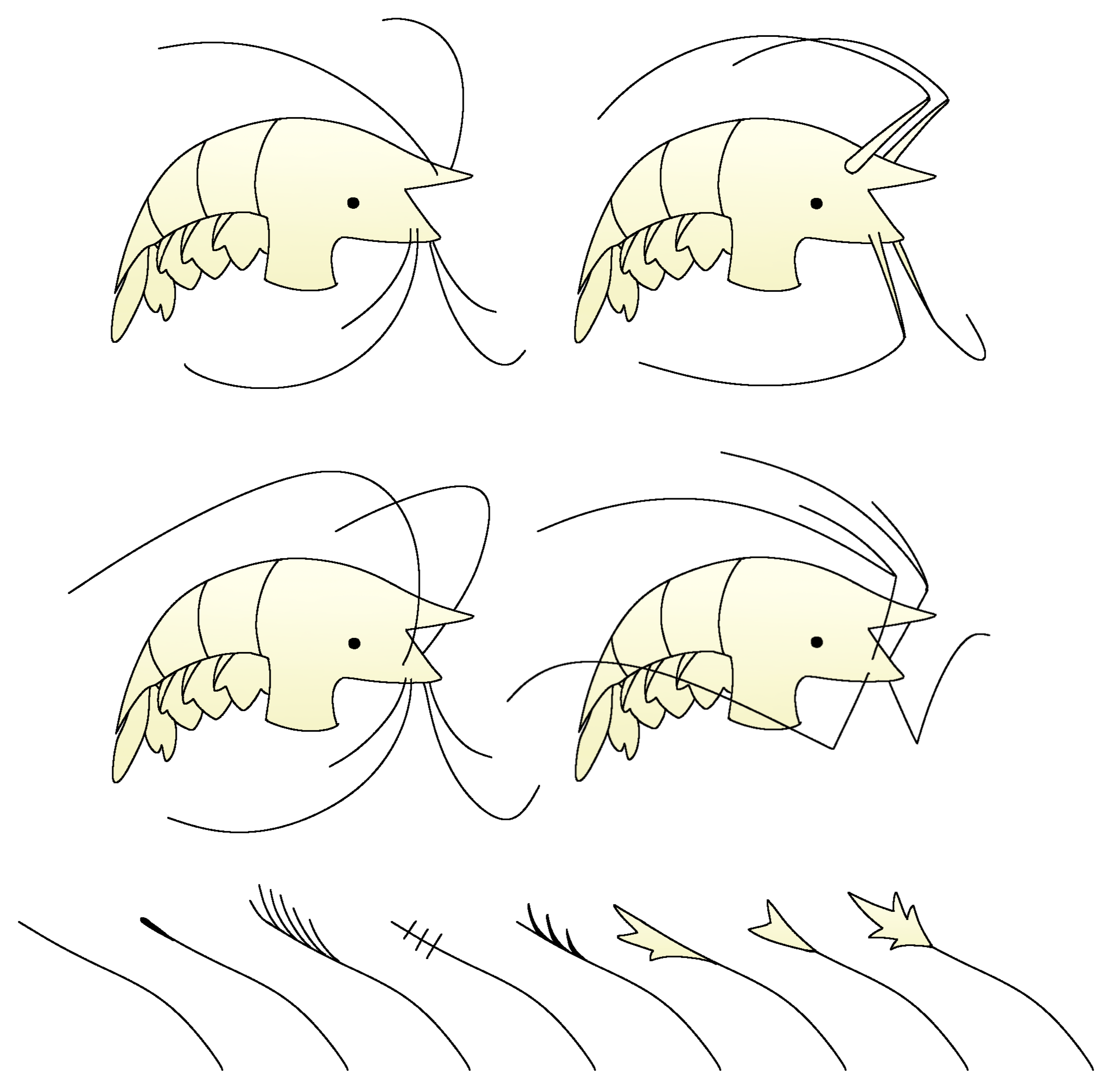
The antennae of a Caridyne include both the smaller, shorter "antennules" and the longer traditional whiskers. These body parts are crucial for detecting changes in the air or water surrounding a shrimp. The smell of food catches on a Caridyne's whiskers and is processed in their Since most Caridyne are short-sighted, these feelers also help prevent bumping into objects while moving around.Antennae also serve a purpose for nonverbal communication. Often times Caridyne will feel each other's antennae to quickly greet each other. Prolonged contact with the antennae of a Caridyne is considered a sign of closeness due to their sensitivity.
Mouth
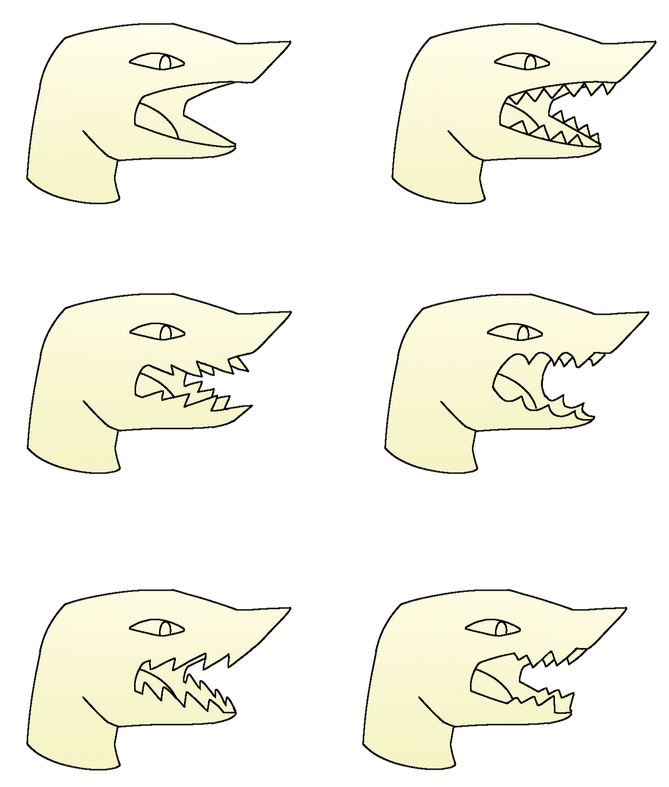
Caridyne mouths possess a wide range of variation in shapes.While Caridyne do not possess true rooted teeth, their external chitin can form pseudo-teeth in different shapes depending on their
Tongue
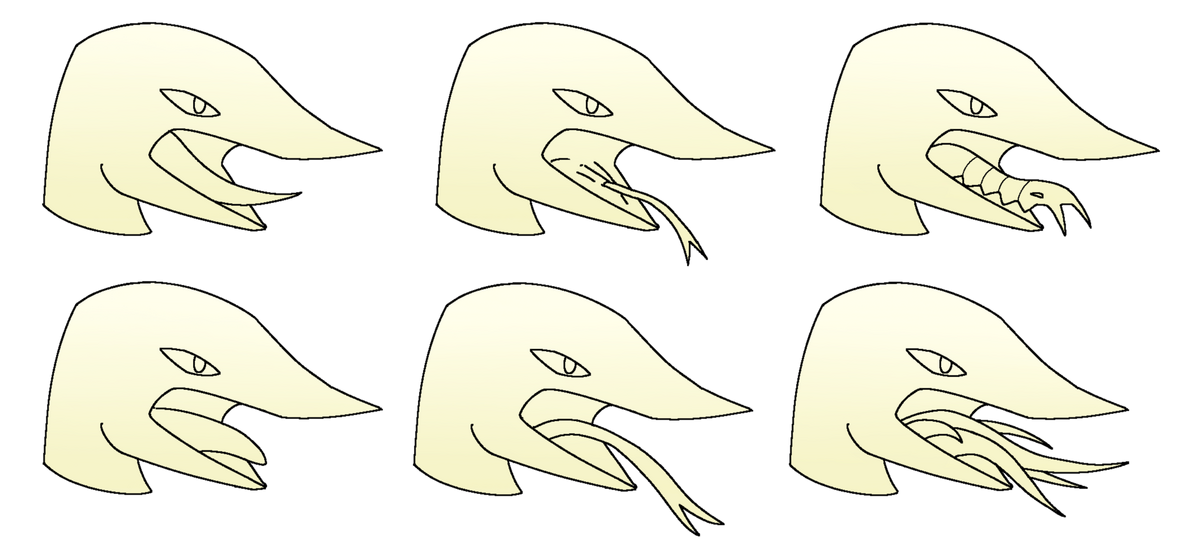
Tongue variations are prominent in Caridyne.
Neck
Necc
Chest
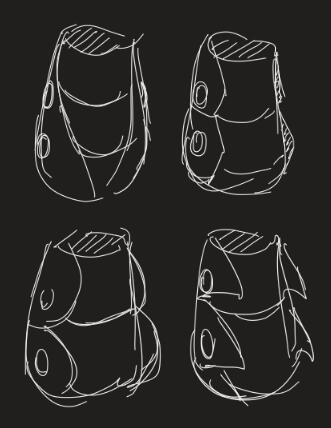
Caridyne chests are covered in hard exoskeleton.

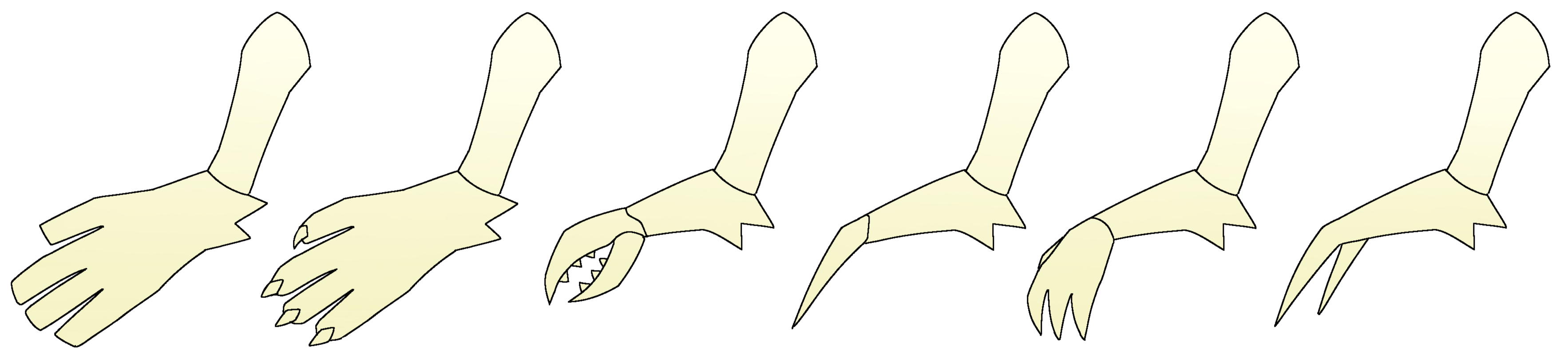
Arms
Claws, hands, points, and pinchers.
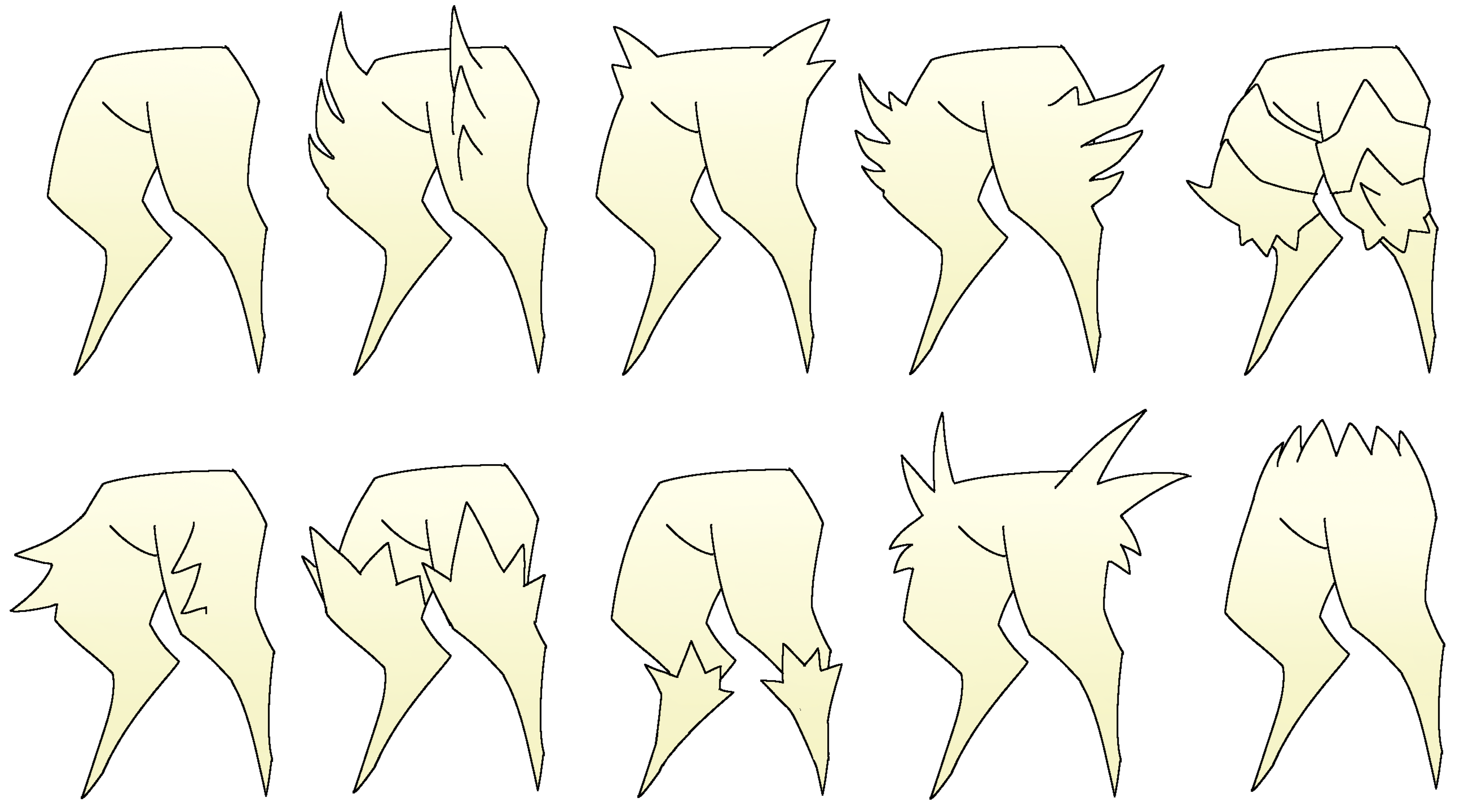
Thighs
Caridyne thighs end in points that protect their body like armor. The patterns are varied.
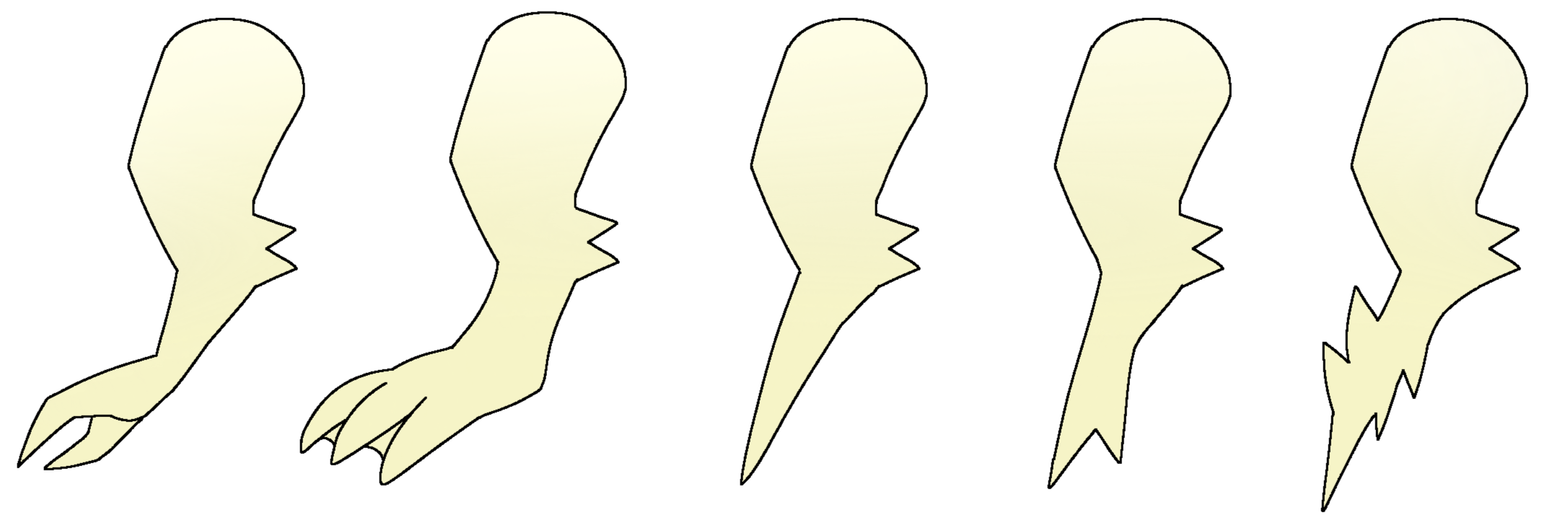
Feet
Walking, swimming, grabbing, and more.
Tail Fan
World
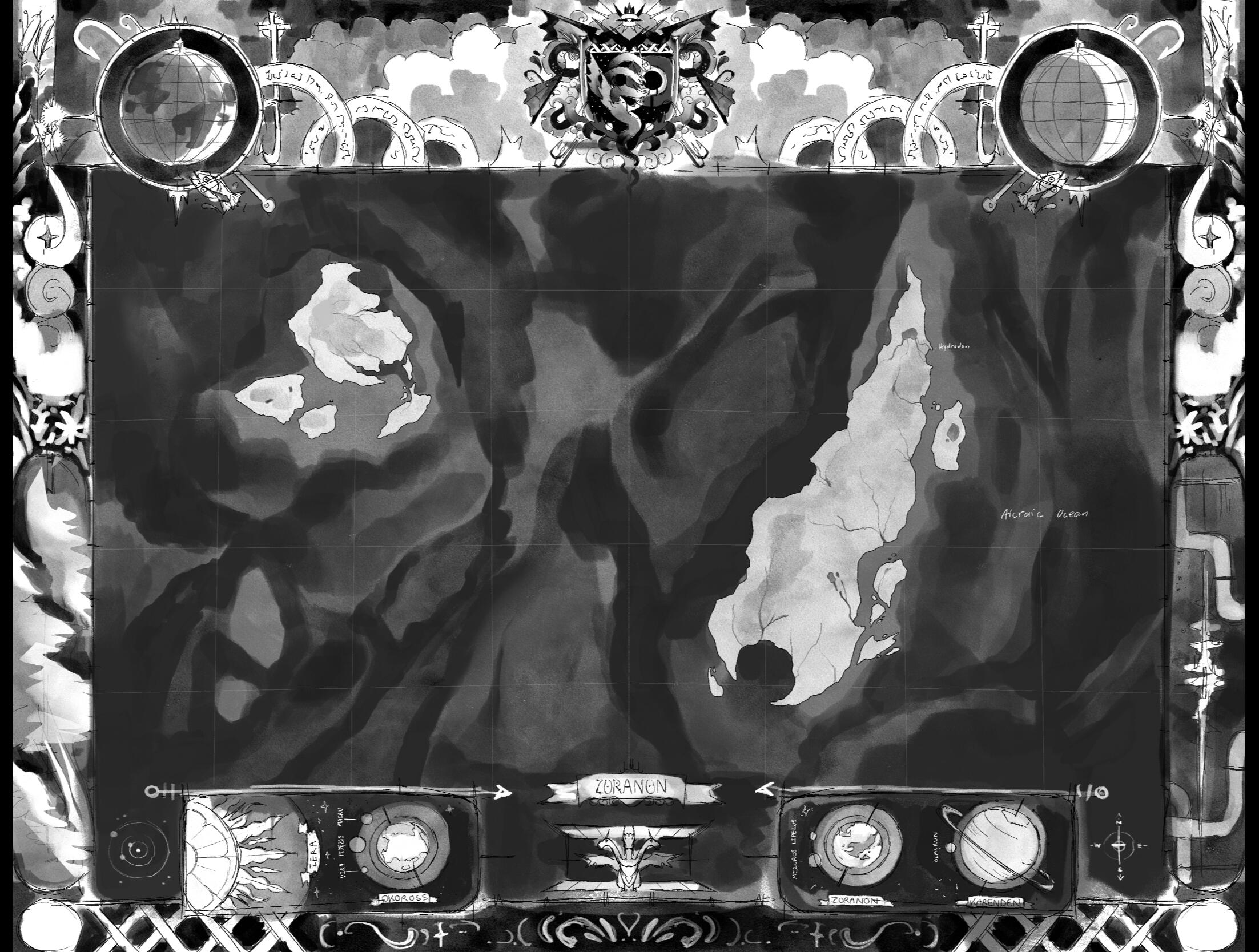
Work in Progress!
Rules/Guidelines
Caridyne as a species are created by Cydroud. Caridyne will always be an open species, so feel free to make your own characters using these ideas as inspiration! If you plan on designing characters to sell, I would like that you give me (Cydroud) a heads up/ask first before doing so. I promise I am not unreasonable. If you make a Caridyne, please show me your creation! I love seeing what other people come up with and it always makes me happy to see what ideas you might have for your very own shrimp!- NSFW art/creations are okay regarding this species, I just ask that it be tagged properly
References
To help those who are interested in creating their very own Caridyne, I will be providing some resources I use to help understand shrimp/crustacean anatomy!Work in Progress!
About the Creator
⭐The creator of the Caridyne species is Cydroud
Hello! My name is Bea, and I have a deep love for all kinds of creatures!What inspired me to create the Caridyne is my appreciation of invertebrates. I think that shrimp as a species are highly underutilized in the anthro community space, and I hope that by putting my ideas out there I can help inspire other people to make their own!I have several fish tanks with Neocaridina shrimp that I keep at home.